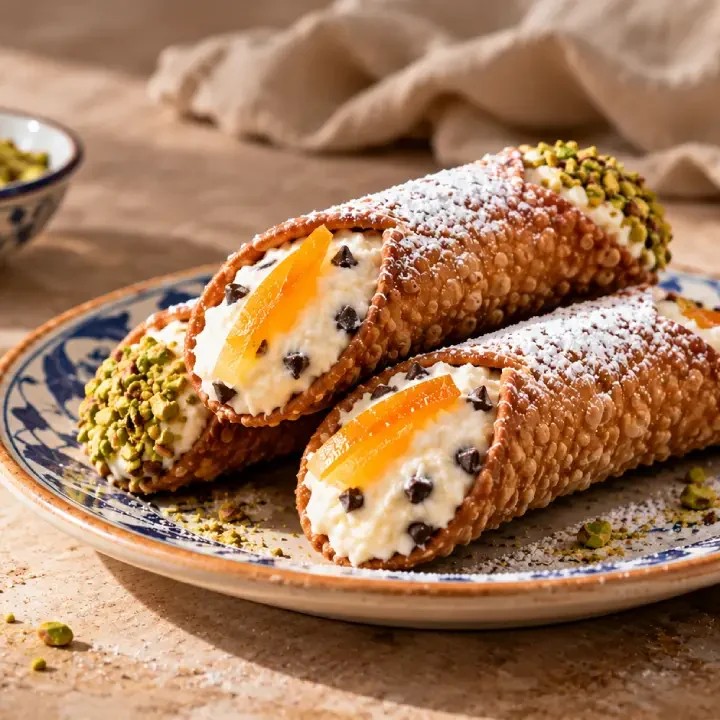
Trying to find out who made the first Sicilian cannolo means stepping into a story where documents and legends constantly cross paths. During our research, we came across Cicero, the Arabs, the women of the harems of Caltanissetta, Sicilian convents, and Carnival.
The problem is that these stories do not all carry the same weight.
Some are supported by historical evidence, while others have been passed down and repeated until they have become almost inseparable from the cannolo itself. So we followed the traces we could find, separating what can be documented from what, however fascinating, belongs to folklore.
Was Cicero Really Talking About Cannoli?
It is one of the most surprising stories we came across.
Marcus Tullius Cicero, who spent time in Sicily during the 1st century BC, is credited with a Latin phrase supposedly describing a cylindrical flour-based preparation filled with a sweet milk-based food:
“Tubus farinarius dulcissimo edulio ex lacte fartus.”
At first glance, it sounds remarkably like a description of a cannolo.
There is a problem, though: we could not find enough evidence to treat that sentence as proof that Cicero knew the Sicilian cannolo as we understand it today.
The quotation appears in much later accounts of Sicilian food history and was repeated, among others, by Alberto Denti di Pirajno in Siciliani a tavola. Even in contemporary accounts, it is often presented somewhere between history and legend.
There is another clue that makes the story even more interesting. In Michele Del Bono’s Dizionario Siciliano-Italiano-Latino, published in Palermo in 1751, we find a description of a pastry shell shaped like a small tube and filled with biancomangiare, accompanied by the same Latin expression that would later be associated with Cicero.
The 18th century therefore gives us an interesting piece of evidence. Taking the cannolo from there all the way back to 1st-century BC Rome, however, requires a leap that the documents available to us simply do not support.
What If It All Began in Arab Sicily?
The best-known story takes us many centuries forward, to Sicily under Islamic rule, between the 9th and 11th centuries.
The place most often mentioned is Caltanissetta.
According to the story, women living in the emir’s harem prepared a cylindrical sweet while their lord was away. In some versions of the legend, even the shape of the cannolo is given a suggestive meaning.
It is a great story to tell. Proving it is another matter.
We found no medieval documents that allow us to attribute the invention of the cannolo to women in a Caltanissetta harem. Even the studies we consulted present this account as part of the popular legends surrounding the dessert.
That does not erase the importance of the Arab presence in Sicily’s culinary history. Islamic culture had a genuine influence on the island’s food and pastry traditions.
But recognizing that influence and knowing who made the first cannolo are two very different things.
Then the Convents Enter the Story
At this point, the setting changes.
One widespread version says that after the end of Islamic rule, some women connected with the Muslim courts converted to Christianity and entered convents. They supposedly brought culinary knowledge and preparations with them.
According to the story, this is how the cannolo travelled from the harems to the monasteries.
It is an intriguing connection, but we found no documents that allow us to follow that journey step by step.
What we do know is that women’s convents played an important role in Sicilian pastry-making. For centuries, they were places where many sweet preparations were created, preserved, and refined.
Cannoli also became part of this tradition.
In Palermo, for example, one legend connects the dessert with the nuns of the monastery of Santa Maria di Monte Oliveto, known as Badia Nuova. The story goes that during Carnival they played a joke by making sweet ricotta come out of a tap instead of water.
It is the perfect story for Carnival. It is far less useful when trying to establish who actually invented the cannolo.
The Name Gives Us a More Concrete Clue
If we have to be cautious about the inventor, the name gives us firmer ground.
Cannolo comes from the Italian word canna, meaning cane or reed.
And this is more than a linguistic resemblance. Before the metal tubes used today became common, the pastry was wrapped around pieces of cane to give it its characteristic tubular shape.
The Sicilian Region’s documentation on Traditional Agri-Food Products still mentions the use of Arundo donax, the common giant reed, to shape the dessert.
Here, the history of the name and the traditional technique fit together much more convincingly.
And the famous tap used by the nuns? It remains a good story, probably helped along by the wordplay surrounding the meaning of cannolo.
Carnival Leaves a Clearer Trail
The further back we look, the more elusive the origins become. With Carnival, however, the picture changes.
In the 19th century, Giuseppe Pitrè, a Palermo physician and ethnographer who devoted much of his work to Sicilian folk traditions, wrote about the cannolu as one of the foods enjoyed during Carnival.
At this point, the cannolo is no longer simply the subject of a story recorded centuries later. We find it firmly placed within a documented Sicilian festive tradition.
Regional sources on traditional food products preserve this connection too, recording the consumption of cannoli during Carnival and Easter.
Today, cannoli can be eaten practically any time of year. Historically, that was not always the case.
When Cannoli Stopped Waiting for Carnival
The move from a festive sweet to a regular presence in pastry shops did not happen overnight.
One particularly interesting trail leads to Piana degli Albanesi and Santa Cristina Gela, where a specific cannoli tradition is recognized by the Sicilian Region.
The evidence collected in regional documentation places cannoli on festive tables there by the late 19th century. From the 1960s onwards, however, production gradually expanded to cover much of the year.
That was an important change.
Cannoli moved beyond the calendar of special occasions and became something pastry shops could prepare regularly. From there, the journey towards becoming one of Sicily’s most recognizable desserts was much shorter.
Nor is there one identical cannolo throughout Sicily. Regional documentation distinguishes, for example, the ricotta cannolo associated with western Sicily from the traditional cannolo of Piana degli Albanesi and Santa Cristina Gela.
A shared history, then, but with local identities that have never completely disappeared.
What Does PAT Recognition Actually Mean?
Today, the Cannolo alla ricotta, or Sicilian cannolo, appears on Sicily’s list of Traditional Agri-Food Products (PAT).
Regional documentation includes references to Paceco, Erice, Trapani, and Valderice. The same register separately records the tradition of Piana degli Albanesi and Santa Cristina Gela.
There is an important distinction to make.
PAT recognition documents the historical connection between a food, its production methods, and a particular area. It does not tell us who invented the cannolo, nor does it turn any of the stories about its origins into an established fact.
This is where, during our research, we found the greatest distance between the history we can document and the version so often repeated online.
So Who Invented the Cannolo?
After following all these trails, we’re still left without a name.
We cannot demonstrate that cannoli already existed in Cicero’s time. We do not have a document attributing their creation to the women of Caltanissetta’s harems. And we cannot reconstruct with certainty a direct journey from the harems to the convents.
What we can trace is how the cannolo evolved.
Cannoli became part of Sicilian tradition, developed a close connection with celebrations and Carnival in particular, appeared in accounts collected during the 19th century, and gradually moved beyond the festive calendar during the 20th century to become a regular feature of pastry shops.
The legends do not have to disappear simply because we cannot prove them. They still tell us something about the way Sicilians have explained and passed down the origins of this dessert over time.
👉 Discover our recipe for Sicilian Cannoli with Sheep’s Milk Ricotta and Fried Shells