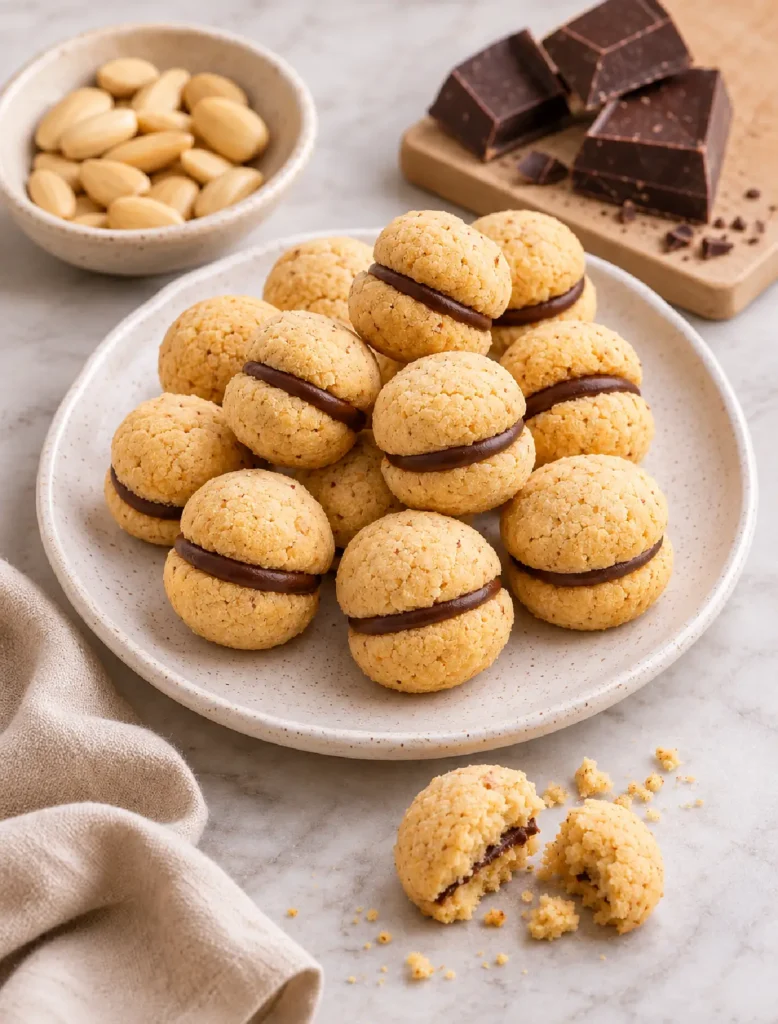
The tricky part of making Baci di Dama isn’t the dough itself. It’s getting dozens of little cookies to come out roughly the same size, with flat bottoms and rounded tops. If they spread too much in the oven, matching them into pairs becomes difficult. That’s why it’s worth taking your time and letting the dough chill properly before baking.
We make our Baci di Dama from Tortona with equal amounts of almonds, flour, butter and sugar, without eggs or baking powder. The almonds are finely ground with sugar, then mixed with the remaining ingredients to form a smooth dough. Once we’ve shaped the dough into small balls, we chill them in the freezer. This is particularly helpful in a warm kitchen, where the butter can soften quickly.
In Tortona, a town in the province of Alessandria in Piedmont, these cookies have a long history and are recognised as a Traditional Agri-food Product (PAT) of the region. The Tortona version uses almonds, while other Piedmontese variations are made with hazelnuts.
We wait until the cookies have cooled completely before adding the melted dark chocolate. A small amount in the centre of one half is enough; we then place the second half on top without pressing too hard. Once the chocolate sets, the two cookies stay together and retain their delicate, crumbly texture.
Baci di Dama Italian Almond Cookies
Description
Two delicate almond cookies joined with a layer of dark chocolate. Our recipe follows the traditional Tortona version, made without eggs or baking powder.
Ingredients for Approximately 40 Baci di Dama
For the Dough
For the Filling
Instructions
How to Make Baci di Dama
-
Toast the Almonds 🌰
Spread the blanched almonds on a baking tray lined with parchment paper. Toast in a preheated conventional oven at 180°C (350°F) for approximately 8–10 minutes, until lightly golden but not browned. Remove from the oven and allow them to cool completely.
-
Grind the Almonds with the Sugar 🥣
Place the almonds in a food processor with half the granulated sugar (75 g / 2.6 oz). Pulse in short bursts, stopping occasionally to prevent the almonds from heating up and releasing their oils. We want a fine, even almond meal, not an almond paste.
-
Prepare the Dough 🧈
Transfer the ground almonds to the bowl of a stand mixer fitted with the paddle attachment. Add the Italian 00 flour, cold butter cut into small cubes, and the remaining 75 g (2.6 oz) of sugar. Mix on low speed until a uniform dough forms, without overworking it. If we don't have a stand mixer, we can combine the ingredients in a bowl and quickly bring the dough together by hand.
-
Chill the Dough ❄️
Shape the dough into a compact block, wrap it in cling film (plastic wrap), and refrigerate for at least 2 hours. This allows the butter to firm up and makes the dough easier to handle.
-
Shape the Dough Balls ⚖️
Remove the chilled dough from the refrigerator and divide it into 80 portions of approximately 7.5 g (0.26 oz) each. Roll each portion gently between the palms of your hands to form a smooth, round ball, without flattening the bottom. Arrange the balls on baking trays lined with parchment paper, leaving approximately 2–3 cm (1 inch) between them. During baking, the bottoms will flatten naturally against the tray while the tops remain rounded.
-
Freeze the Dough Balls 🧊
Place the trays in the freezer for at least 1 hour, until the dough balls are firm. If there isn't enough room for the trays, arrange the balls on a parchment-lined plate or smaller tray and transfer them to the baking trays just before cooking.
-
Bake the Cookies 🔥
Preheat a conventional oven to 140°C (285°F). Bake one tray at a time, transferring the dough balls directly from the freezer into the hot oven. Bake for approximately 15–17 minutes, until the cookies are set, lightly golden underneath and still fairly pale on top. Avoid overbaking, as the cookies should not become too dark.
-
Allow the Cookie Halves to Cool ⏳
Remove the trays from the oven and leave the cookies to cool completely on them. They are extremely delicate while hot and may break if moved too soon. As they cool, they become firmer and easier to handle.
-
Melt the Dark Chocolate 🍫
Finely chop the dark chocolate and melt it gently in a heatproof bowl set over a pan of hot water, making sure the bottom of the bowl does not touch the water. Stir until smooth, then allow the chocolate to cool slightly, stirring occasionally, until it thickens to a creamy consistency rather than remaining very runny.
-
Assemble the Baci di Dama 🤎
Match the cookie halves into pairs of similar size. Using a teaspoon or piping bag, place a small amount of chocolate in the centre of the flat side of 40 cookies. Gently place the remaining halves on top, pressing just enough to join them without breaking the cookies or squeezing out the chocolate. Arrange the assembled Baci di Dama on a tray and allow the chocolate to set completely before serving.
Nutrition Facts
Servings 10
- Amount Per Serving
- Calories 400kcal
- % Daily Value *
- Total Fat 27.1g42%
- Saturated Fat 12.3g62%
- Sodium 12mg1%
- Total Carbohydrate 35.7g12%
- Dietary Fiber 2.5g10%
- Sugars 19.4g
- Protein 6.1g13%
* Percent Daily Values are based on a 2,000 calorie diet. Your daily value may be higher or lower depending on your calorie needs.
Note
Storage: Store Baci di Dama in a tin or airtight container in a cool, dry place for approximately 7 days. Make sure the chocolate has set completely before putting them away. Avoid refrigeration where possible, as moisture can affect the cookies' delicate, crumbly texture.
Freezing: We can prepare the dough balls ahead of time and freeze them before baking. Once firm, transfer them to a well-sealed freezer bag and store for up to approximately 2 months. When ready to bake, arrange them on a baking tray and cook directly from frozen, checking for doneness.
Cookie Size: Keep the dough balls small and uniform in weight. If they are too large, the outside may cook before the centre, leaving the cookies less evenly baked and affecting their characteristic crumbly texture.
Almond Flour: We can replace the 150 g (5.3 oz) of blanched almonds with the same weight of finely ground almond flour, also called ground almonds or almond meal in some countries. Choose a product made entirely from almonds, with no added sugar. In this case, skip the toasting and grinding steps and add the almond flour directly to the dough.
Hazelnut Variation: To make hazelnut Baci di Dama, replace the 150 g (5.3 oz) of almonds with the same amount of blanched hazelnuts. We can also use 75 g (2.6 oz) each of almonds and hazelnuts. These are variations on the almond-based Tortona recipe we have chosen.
Chocolate Filling: Dark chocolate is used in our recipe, but milk or white chocolate can also be substituted for a sweeter result. Avoid filling the cookies while the chocolate is still very hot and runny, as it may spread beyond the edges.