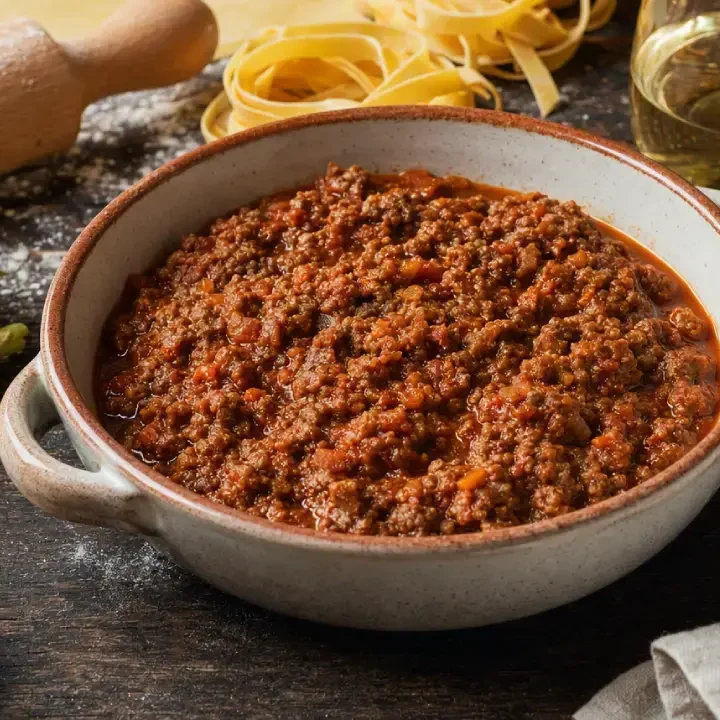
Ragù alla Bolognese is one of Italy’s best-known meat sauces. Yet compare a few recipes and the differences soon appear: more or less tomato, beef alone or a mixture of meats, milk or no milk, and cooking times that can vary considerably.
Even in Bologna, ragù has never followed an identical formula in every home. There is, however, a registered recipe, created to put the most recognisable characteristics of the preparation into writing. The first version was registered in 1982; in 2023, following new research, an updated recipe was registered with the Bologna Chamber of Commerce.
Before Bolognese Ragù, There Was Ragoût
The word ragù did not originate in Bologna, or even in Italy. It comes from the French ragoût, a term related to the verb ragoûter and to goût, meaning “taste”. It referred to rich, flavourful meat preparations cooked slowly.
As the term entered the Italian language and Italian cooking, both its spelling and meaning changed. Ragoût became ragù, but it did not come to describe a single preparation.
Different regional cuisines developed very different interpretations. In Naples, a tradition emerged around pieces of meat slowly cooked in tomato sauce; in Bologna, minced meat took a central role. The name may be the same, but the structure and techniques are quite different.
When Did Ragù alla Bolognese Appear?
There is no single date that can confidently be identified as the birth of Ragù alla Bolognese. The preparation developed gradually, and written recipes allow us to trace only some stages of that evolution.
A preparation resembling modern Bolognese ragù appears in the 1931 Guida gastronomica d’Italia published by the Touring Club Italiano, also referenced in the historical chronology of Bologna’s Biblioteca Salaborsa.
Written sources tell only part of the story. Ragù belongs above all to home cooking and, like many preparations of this kind, has been passed down with differences in the choice of meat, proportions and method.
1982: The First Registered Recipe
On 17 October 1982, the Bologna Delegation of the Accademia Italiana della Cucina registered a recipe for Ragù alla Bolognese with the Bologna Chamber of Commerce.
Among the ingredients was cartella di manzo, a cut of beef from the diaphragm area traditionally used for this preparation. The meat was accompanied by pancetta, onion, carrot and celery, tomato, wine, milk and stock.
Cooking took time. Tomato was not intended to dominate the sauce, and the finished ragù was a concentrated preparation in which the meat, fat and vegetables came together into a rich, cohesive sauce.
This became the first formally registered reference for a preparation that had previously been preserved mainly through culinary practice, existing written recipes and family traditions.
The 2023 Update
More than forty years later, some aspects of the 1982 formula no longer reflected contemporary cooking with the same accuracy. The availability of certain cuts of meat had changed, along with kitchen equipment, heat sources and, to some extent, eating habits.
The three Bologna Delegations of the Accademia Italiana della Cucina formed a Study Committee. Its research involved restaurants in Bologna, families with long-established Bolognese culinary traditions and food experts, using a questionnaire focused on how ragù was actually being prepared.
The responses revealed differences in the meats used, quantities and several technical details. Rather than one identical formula repeated from kitchen to kitchen, the research found a shared foundation surrounded by different practices.
On 20 April 2023, the new recipe for Ragù alla Bolognese was formally registered with the Bologna Chamber of Commerce through a notarial deed.
The Ragù alla Bolognese Recipe Registered in 2023
The main recipe, serving six, calls for 400 g coarsely minced beef and 150 g fresh pork pancetta. Onion, carrot and celery are used in quantities of approximately 60 g each.
There is considerably less tomato than in many sauces known internationally as Bolognese: 200 g tomato passata and one tablespoon of double-concentrated tomato paste. Red or white wine, beef stock or light vegetable stock, extra virgin olive oil, salt and pepper complete the ingredients.
Whole milk is optional.
The proportions reveal much about the character of the dish. Meat remains the main component, while the tomato supports the other ingredients rather than turning the ragù into a predominantly tomato-based sauce. During the long cooking time, the mixture gradually reduces and develops a thick, cohesive consistency.
Stock is added as needed to continue cooking without allowing the ragù to become too dry. If milk is used, it is added towards the end.
Recognised Variations
Alongside the main formula, the 2023 registration identifies several variations considered compatible with the tradition.
Beef alone can be replaced with a mixture of approximately 60% beef and 40% pork. The meat may be chopped with a knife, while flat or rolled pancetta can replace fresh pancetta. A light touch of nutmeg is also permitted.
Other ingredients remain outside the reference recipe, including veal, smoked pancetta, garlic, rosemary, parsley, other herbs or spices, brandy and flour.
The documentation also mentions traditional additions such as chicken offal, sausage, peas or dried porcini mushrooms.
These guidelines leave room for differences in home cooking while still drawing fairly clear boundaries around the preparation.
A Reference Point, Not a Rulebook
The registered recipe is not a rigid set of rules that automatically makes every different version incorrect.
The 2023 documentation is clear on this point: the formula is not intended to be the only possible recipe for Ragù alla Bolognese. It is a reference designed to represent the classic and traditional character of the preparation, based on research carried out in Bologna.
A family recipe may therefore use different proportions or one of the recognised variations. The registration provides a documented reference against which the many meat sauces described simply as Bolognese, particularly outside Italy, can be understood.
Ragù and Tagliatelle
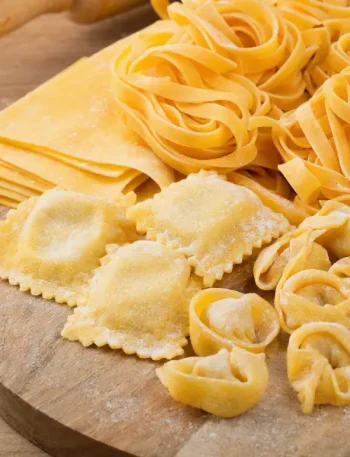
In Bologna, ragù is associated above all with fresh egg pasta and tagliatelle.
The Tagliatella di Bologna also has an officially registered reference: its traditional measurements were deposited with the Bologna Chamber of Commerce in 1972.
Fresh egg pasta provides a surface that holds a thick, meat-rich ragù well, while the width of tagliatelle allows the sauce and minced meat to distribute evenly along the pasta.
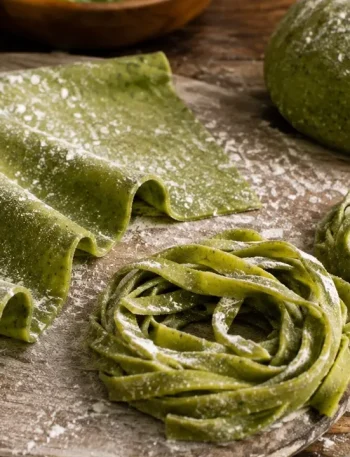
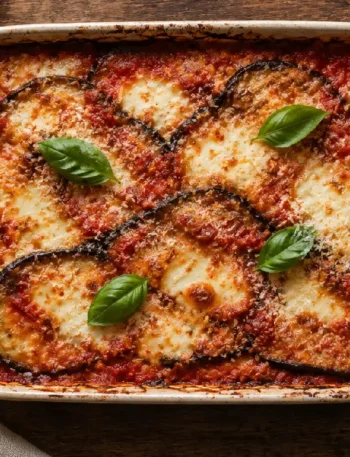
Ragù also has another fundamental place in Bolognese cooking. It is used in Lasagne Verdi alla Bolognese, layered with green egg pasta sheets, béchamel and Parmigiano Reggiano.
Tagliatelle and lasagne explain the role of ragù in Bolognese cooking better than any definition. It is not simply a generic pasta sauce, but a preparation closely connected to particular dishes and types of pasta.
What About Spaghetti Bolognese?
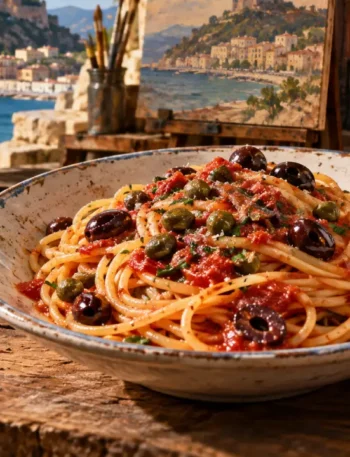
Spaghetti Bolognese followed a different path. Outside Italy, it has become one of the world’s best-known dishes associated with Italian cooking, and in many countries Bolognese now broadly describes a tomato and meat sauce served with pasta.
In Bologna, the traditional pairing is instead with egg tagliatelle.
Describing Spaghetti Bolognese simply as a “wrong” version of the Bolognese dish tells us very little about its history. It is better understood as an international adaptation: the name remained, while the pasta, ingredients and proportions changed to suit the cooking traditions and tastes of the countries where the dish became popular.
Spaghetti Bolognese now has a history of its own, largely written outside Bologna. The ragù that carries the city’s name, meanwhile, remains closely associated with fresh egg pasta: a light touch of tomato, meat at the centre, and a cooking time that cannot be rushed.
Would you like to make Ragù alla Bolognese following the reference recipe registered in 2023?