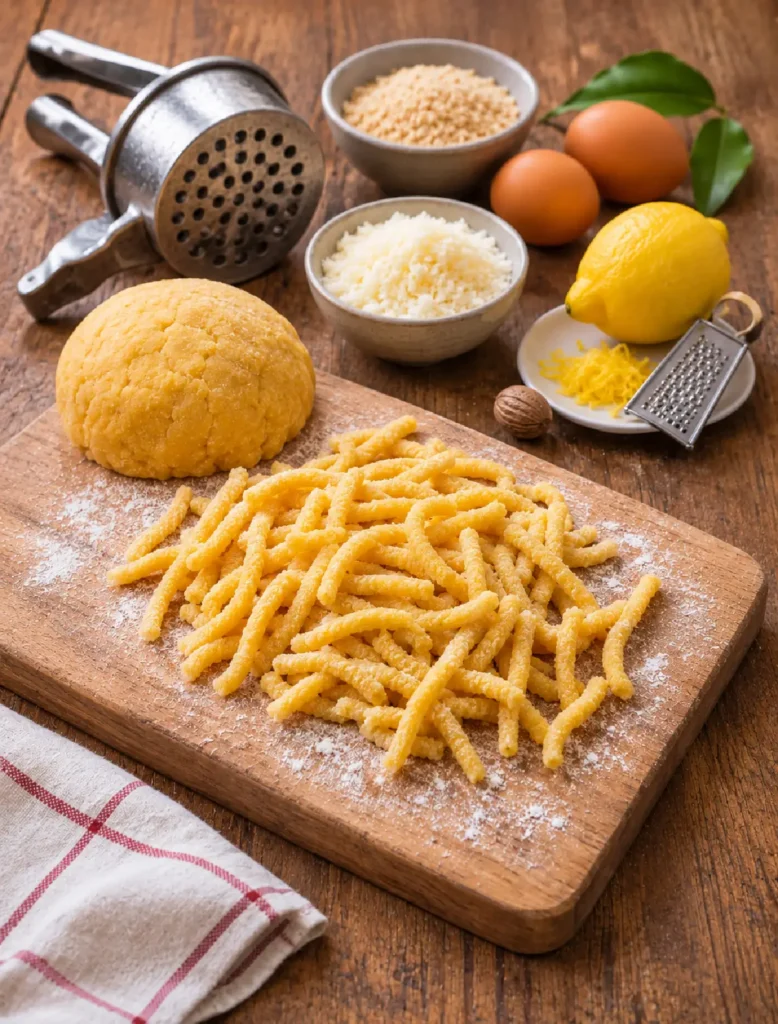
Making homemade passatelli pasta doesn’t involve rolling out dough or using a pasta machine. Everything comes together in a bowl, and once the mixture is firm enough, we press it through a traditional passatelli press or a potato ricer with large holes. What comes out are short, thick strands of pasta, ready to cook.
What makes this pasta from Romagna unusual is its ingredients: breadcrumbs, Parmigiano Reggiano and eggs, with no flour added. The bread needs to be thoroughly dried and finely ground so it can absorb moisture from the eggs and help the strands hold their shape. Nutmeg and lemon zest bring a little extra fragrance without overpowering the cheese.
Making passatelli from scratch gives us a versatile starting point for different dishes. We can cook them in meat broth, as traditionally done in Romagna, or serve them with a sauce. Either way, getting the texture right matters most: the mixture should pass through the press without too much difficulty while remaining firm enough to hold together during cooking.
Homemade Passatelli Pasta
Description
Homemade passatelli made with breadcrumbs, Parmigiano Reggiano, eggs, nutmeg and lemon zest. A traditional pasta preparation from Romagna that can be cooked in broth or served with different sauces.
Ingredients
Instructions
How to Make Homemade Passatelli Pasta
-
Mix the Breadcrumbs and Parmigiano 🥣
Place the breadcrumbs in a large bowl and add the grated Parmigiano Reggiano. Grate in the zest of half a lemon, using only the yellow outer layer, and add a little freshly grated nutmeg. Mix well to distribute everything evenly.
-
Add the Eggs 🥚
Crack the eggs into a separate bowl, add a pinch of salt and beat with a fork. Gradually pour the eggs into the breadcrumb and cheese mixture, stirring first with a fork and then using your hands. Before adding the last of the beaten egg, check the consistency of the mixture.
-
Work the Dough by Hand ✋
Continue mixing and kneading until you have a firm, uniform dough that can be shaped into a ball. It should hold together when pressed, without crumbling or sticking excessively to your fingers. Unlike traditional egg pasta dough, passatelli dough doesn't need prolonged kneading. We only need to combine the ingredients thoroughly.
-
Let the Dough Rest ⏱️
Cover the dough with plastic wrap or an inverted bowl and leave it to rest at room temperature for 30 minutes. During this time, the breadcrumbs will absorb some of the moisture from the eggs, giving the dough a more even consistency.
-
Check the Consistency 🔍
Take a small piece of dough and try pressing it through the potato ricer. If the strands crumble as they come out, work in a very small amount of beaten egg. If the mixture is too soft and the strands won't hold their shape, add a little breadcrumbs and Parmigiano Reggiano in equal amounts. Mix again and repeat the test.
-
Shape the Passatelli 🍝
Divide the dough into 2–3 portions. Place one portion at a time in a traditional passatelli press or a sturdy potato ricer with holes at least 5 mm (0.2 inches) wide. Press firmly to form the strands, cutting them with a knife into lengths of approximately 5–6 cm (2–2.4 inches).
-
Arrange the Passatelli on a Tray 🍽️
Gently arrange the passatelli on a tray in a single layer, without overlapping them. Continue until all the dough has been used, handling the freshly formed strands as little as possible.
Our homemade passatelli are now ready to use in the recipe of our choice.
Note
Which breadcrumbs should we use? Choose plain stale bread that has dried thoroughly and contains no added fats. Avoid seasoned breadcrumbs, as the herbs and spices would change the flavour of the passatelli.
Traditional passatelli press or potato ricer? The traditional press is specifically designed for making passatelli, but a sturdy potato ricer with holes at least 5 mm (0.2 inches) wide is a practical alternative. Smaller holes produce thinner, more delicate strands that are more likely to break.
How should we store them? We can keep the dough well covered in the refrigerator for approximately 24 hours. For longer storage, arrange the shaped passatelli on a tray, freeze them separately, then transfer them to a freezer-safe container. For best quality, use them within 1–2 months and cook them directly from frozen.
Can we make them ahead? Yes. However, if we aren't planning to cook them soon, it's better to freeze the shaped passatelli rather than leave them on a tray at room temperature for an extended period.