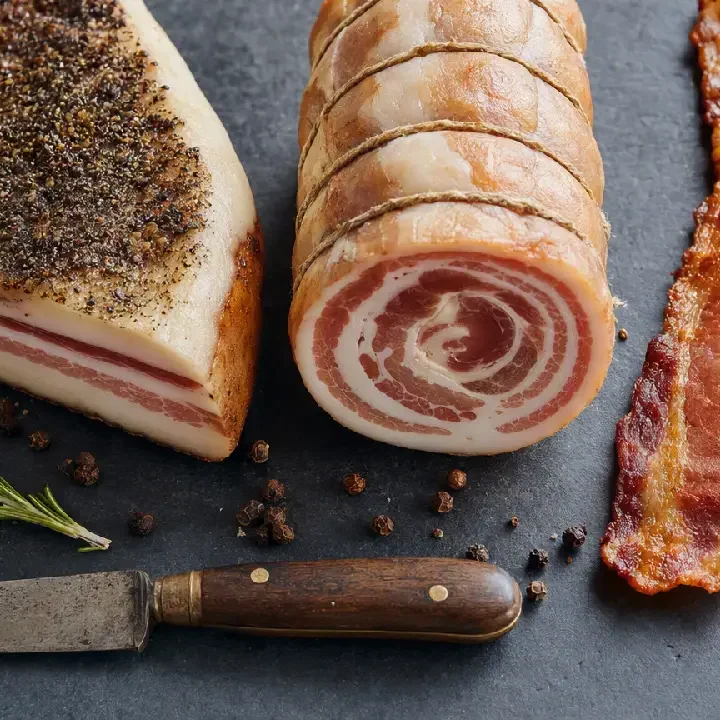
Guanciale, pancetta and bacon have one obvious thing in common: they all come from pork. Beyond that, treating them as interchangeable creates more confusion than clarity.
Pancetta comes from pork belly, while guanciale comes from the cheek and jowl area. Bacon is a broader term because it covers different products depending on the country and how they are made. In the case of streaky bacon, the cut is pork belly, just like pancetta, but the processing and characteristics of the finished product are different.
The cut, curing, seasonings, ageing and possible smoking do the rest. Then comes the real test: the pan.
Pancetta and guanciale come from different cuts
Italian pancetta is made from pork belly, where layers of fat and lean meat create its characteristic appearance when sliced. After trimming, it is salted, and the cure may include pepper, herbs and other seasonings.
It can be left flat, rolled or pressed, or it may be smoked, with ageing times varying according to the product. Even within the Italian tradition, then, pancetta can take quite different forms.
Regional specialities make this particularly clear. Pancetta Piacentina DOP, for example, is dry-salted, rolled and aged for at least four months. Its cure also includes black pepper and other ingredients permitted by its production specifications. In Calabria, the processing and seasonings change: Pancetta di Calabria DOP also makes use of chilli pepper. Very different products can sit behind the same name.
Guanciale starts with a different cut. It is made from the cheek and jowl area of the pig, then salted, seasoned and aged. The cure varies according to the region and producer: it may be relatively simple or develop stronger notes from chilli pepper, garlic or herbs.
But the differences become especially clear once you turn on the heat. Guanciale contains a substantial amount of fat that renders slowly as it cooks. Some of the meat remains firm and can become golden, while the rendered fat stays in the pan. In Roman pasta dishes, that is where the sauce begins.
You can see this clearly in Pasta alla Gricia. There are very few ingredients, and the rendered guanciale fat works with the pasta water and Pecorino Romano to give the dish its structure. Spaghetti all’Amatriciana adds tomato to the equation, while Pasta alla Zozzona brings in sausage, egg yolks and Pecorino.
Pancetta can play a very different role. In Ragù alla Bolognese, for example, fresh pancetta is finely chopped and cooked at the beginning. It releases its fat and becomes part of the base on which the ragù is built.
Bacon is not the English translation of pancetta
This is probably one of the most common sources of confusion, especially outside Italy.
Translating pancetta simply as bacon may be convenient, but the two terms are not gastronomically equivalent. Bacon belongs to different culinary and production traditions, and both the cuts and processing methods can vary.
Streaky bacon, widely used in the United States, is the type that most closely resembles pancetta in appearance because of its alternating layers of fat and meat. In the United Kingdom, back bacon is also common. It is cut mainly from the loin and is considerably leaner.
Bacon is cured, either dry or in brine depending on the product, and it may also be smoked. That smoky character becomes particularly noticeable when bacon is used in place of an Italian cured pork product.
A Carbonara made with smoked bacon does not change only in terms of authenticity: it genuinely tastes different. In a dish made with so few ingredients, the smoky flavour is immediately noticeable.
When guanciale is hard to find
Outside Italy, recipes still sometimes translate guanciale simply as bacon. For Carbonara, Gricia and Amatriciana, when a recipe calls for guanciale, guanciale remains the first choice.
When it is unavailable, unsmoked pancetta can come closer to its flavour profile than strongly smoked bacon. The cut, fat and flavour will still be different.
With smoked bacon, the difference becomes more pronounced: the smoky note immediately enters the dish and changes the character of these Roman pasta dishes.
And often, the first bite is enough to notice it.