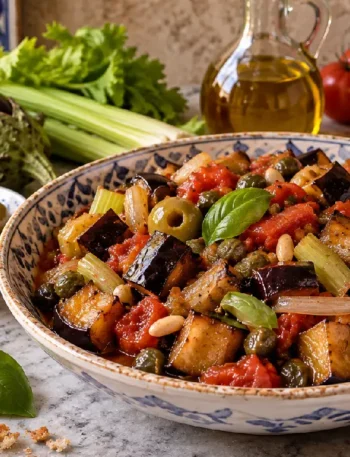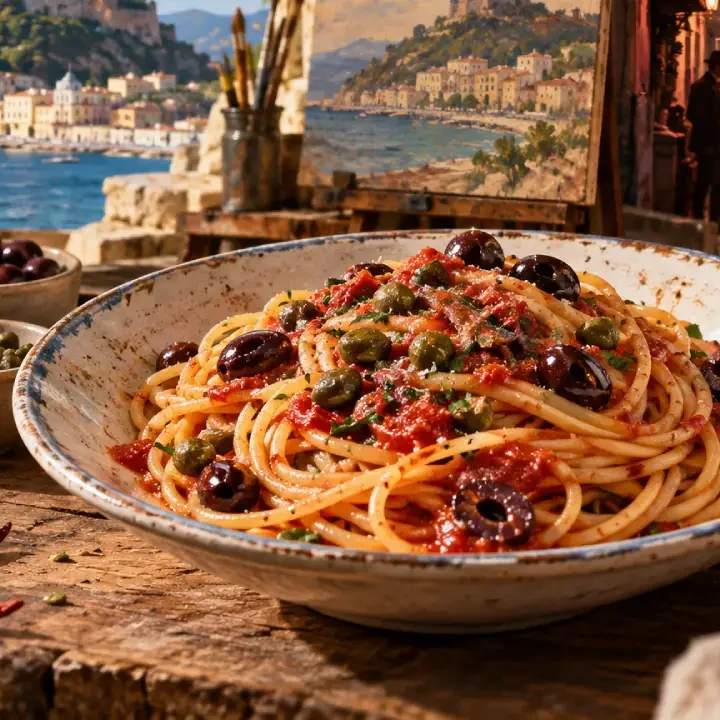
Few names in Italian cooking attract as much attention as Pasta alla Puttanesca. Tomato, olives, capers, anchovies, garlic and chilli make a bold, intensely flavoured sauce, but there is nothing in those ingredients that immediately explains the name.
And this is where the story gets complicated.
Several explanations have grown up around puttanesca. The best-known involves the brothels of Naples, but other accounts take us somewhere quite different: to Ischia, the painter Eduardo Colucci and, later, Sandro Petti.
One thing, however, seems fairly clear: pasta very similar to puttanesca existed before people started calling it by that name.
Before puttanesca, there were olives and capers
To find an ancestor of the dish, we need to go back to nineteenth-century Neapolitan cooking.
In his Cucina teorico-pratica, Ippolito Cavalcanti includes Vermicelli all’oglio con olive capperi ed alici salse. The dish already contains several elements we associate with puttanesca today, although tomato is still missing.
An even closer reference appears in 1931.
The Touring Club Italiano’s Guida gastronomica d’Italia lists maccheroni alla marinara among the specialities of Campania. The pasta is dressed with a tomato sauce made with olive oil, garlic and parsley, with capers and olives added to it.
By this point, almost all the essential ingredients are there.
The name, however, is still alla marinara.
From “alla marinara” to “alla puttanesca”
This is where Jeanne Caròla Francesconi, one of the most important writers to document Neapolitan cooking, enters the story.
In her book La cucina napoletana, published in 1965, Francesconi explains that these maccheroni had been known as alla marinara and that, shortly after the Second World War, the painter Eduardo Colucci in Ischia gave them the name by which we know them today.
Why he chose it is not explained.
Colucci spent his summers in Ischia, where he entertained friends and guests at his home in Punta Molino. Among the dishes he was known to prepare were maccheroni with olives and capers, particularly for impromptu dinners.
The account is especially interesting because it comes from an author who researched and documented Neapolitan cooking extensively.
But it is not the only story that leads to Ischia.
Sandro Petti and the “puttanata qualsiasi”
Another version centres on Sandro Petti, Eduardo Colucci’s nephew and a figure in Ischia’s lively social scene during the 1950s.
Petti was associated with the famous ‘O Rangio Fellone. According to his account, one night some hungry friends asked him to make them something to eat when there was very little left in the kitchen.
Petti supposedly told them that he did not have enough ingredients to prepare a proper dinner. They insisted, essentially telling him to make “una puttanata qualsiasi”, roughly meaning any old thing or whatever he could throw together.
Using what he had available, Petti put together pasta, tomato, olives, capers and the other ingredients he could find in the kitchen.
According to this version, the name of the dish grew out of that remark.
It is a memorable story, and it also offers a different explanation for the word: not a direct reference to prostitution, but the colloquial use of puttanata for something thrown together without much planning, using whatever happens to be available.
There is a problem, though. Francesconi’s account already associates the change of name with Petti’s uncle, Eduardo Colucci. The two stories from Ischia therefore do not fit together perfectly.
What about the story of the brothels?
This is probably the best-known explanation.
According to a widely repeated version, the pasta was prepared in the brothels of Naples’ Quartieri Spagnoli. It was quick to make, relied on ingredients that could be kept on hand and could therefore be cooked between customers.
Another variation claims that the colours of the dish recalled the bright clothes worn by the women working in the brothels: the red tomato, green parsley, dark olives and capers.
The difficulty is finding historical evidence that securely connects these stories with the origin of the name. They have been repeated many times, but the available accounts also point in very different directions.
It is therefore safer to treat them as legends surrounding the origins of puttanesca, rather than as a definitive explanation.
When does the name “puttanesca” first appear in writing?
Here we have at least one useful fixed point.
In 1961, Raffaele La Capria published his novel Ferito a morte. The book contains a reference to “spaghetti alla puttanesca”.
This tells us that by the beginning of the 1960s the name was already familiar enough to appear in a literary work without requiring any particular explanation.
It also matters when considering the stories set during the 1950s. It does not tell us who invented the name, but it does confirm that “alla puttanesca” was already in circulation by 1961.
So why is it called Pasta alla Puttanesca?
We probably do not have a definitive answer.
We do know that Neapolitan cooking had included pasta dressed with olives, capers and other ingredients now associated with puttanesca for a long time. There is already a predecessor in the nineteenth century, while in 1931 we find a dish called alla marinara that comes remarkably close to the modern version.
After the war, the story moves to Ischia. Jeanne Caròla Francesconi associates the new name with Eduardo Colucci, while Sandro Petti later told the story of the “puttanata qualsiasi”. Meanwhile, the stories connecting the dish with Neapolitan brothels became much better known, despite being considerably harder to document.
The sauce, in other words, does not appear to have been born together with its name. Olives, capers, tomato and pasta had already found their way into the same dish before the word “puttanesca” appeared. Exactly who first decided to call it that remains open to question.