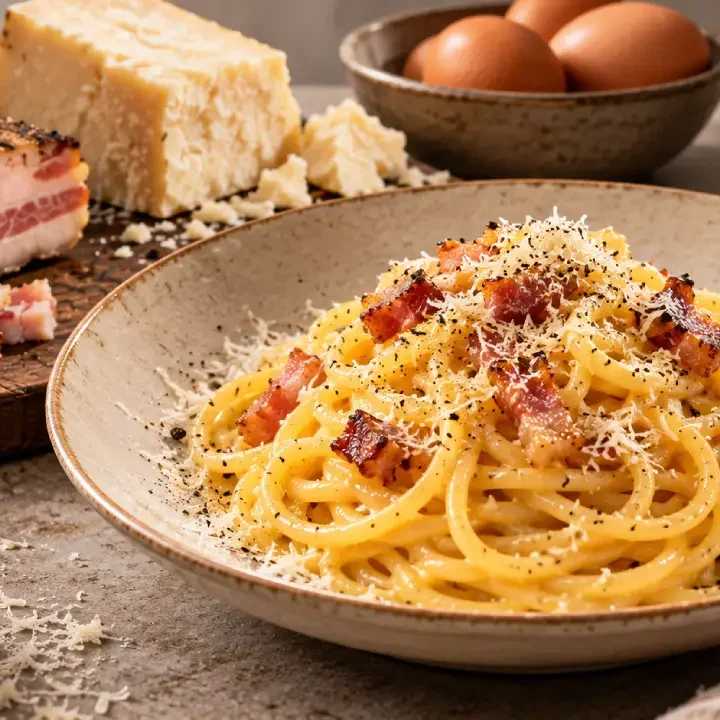
In August 1939, a Dutch journalist wrote about an evening she had spent in Rome. Her name was Norah Koch Berkhuijsen, and among the places she described were two trattorias overlooking Piazza Santa Maria in Trastevere. One served shrimp risotto, the other spaghetti alla Carbonara.
That brief reference would remain buried in the archives for almost ninety years. Then, in February 2026, it resurfaced, challenging one of the most familiar stories about Italian food: that Carbonara was invented during the Second World War thanks to American soldiers.
In 1939, the Allied troops had not yet arrived in Rome. Yet someone in a Trastevere trattoria was already serving a dish called spaghetti alla Carbonara.
We do not know how it was prepared. The journalist recorded neither the ingredients nor the method. But her account pushes back the documented history of the dish and casts new light on the evidence that emerged in the following decades.
Carbonara in Trastevere Before the War
The article appeared on 23 August 1939 in De Koerier, a Dutch-language newspaper published in the Dutch East Indies, then under Dutch colonial rule.
Norah Koch Berkhuijsen described the atmosphere of Rome on summer evenings, focusing particularly on Piazza Santa Maria in Trastevere. Two trattorias stood on the square, Umberto and Alfredo, whose owners had known each other for generations despite being competitors. In summer, they set up tables outside, attracting both Romans and visitors.
The journalist also mentioned the specialities of the two restaurants. One offered shrimp risotto, while the other served spaghetti alla Carbonara, accompanied by a Dutch explanation associating the dish with pasta prepared by a charcoal burner’s wife.
This detail is particularly interesting because the dish’s name is still frequently linked to charcoal workers.
The account was brought to public attention in February 2026 through research by Dutch journalists Edwin Winkels and Janneke Vreugdenhil, who subsequently shared their findings with food historian Luca Cesari and Alberto Grandi, a professor of food history.
It is not the only document pointing towards Trastevere. On 1 May 1948, Renato Mucci published an article in the Giornale di Trieste entitled La più bella piazza di Roma (Rome’s Most Beautiful Square), once again mentioning spaghetti alla Carbonara served in the trattorias of Piazza Santa Maria.
The two accounts may have referred to the same restaurant, although there is not enough evidence to establish this.
Carbonara also appeared in other accounts from the period. On 26 July 1950, La Stampa published an article about the Festa de Noantri, describing American officers who had arrived in Trastevere looking for spaghetti alla Carbonara.
In the 1951 film Cameriera bella presenza offresi, Aldo Fabrizi asks a woman applying for a domestic position whether she knows how to prepare the dish. She replies that she does not, and he moves on to ask about Amatriciana.
The exchange lasts only a few moments, but it is revealing. Carbonara was already familiar enough to be mentioned in a film without any particular explanation.
The War, the Americans and Renato Gualandi’s Story
For decades, one of the most widespread theories linked the invention of Carbonara to the arrival of Allied troops in Italy during the Second World War.
American soldiers had access to foods such as bacon and egg products, which could be combined with pasta and cheese. According to this theory, an Italian cook used military supplies to create a new sauce that eventually became Carbonara.
The explanation also seemed plausible because the earliest written recipes frequently used pancetta rather than guanciale.
One of the central figures in this story is Renato Gualandi, a chef from Bologna who claimed to have prepared Carbonara on 22 September 1944 in Riccione, during a meeting between officers of the British Eighth Army and the American Fifth Army.
According to his account, he used ingredients available through military supplies, including bacon, egg products, cheese and cream. Gualandi later worked in Rome for the Allies, which has encouraged the theory that he helped introduce or popularise the dish in the capital.
The difficulty is that his account was reconstructed many years after the event. No contemporary documents from 1944 establish that this was the first Carbonara or that Gualandi invented it.
The 1939 evidence makes the claim even harder to sustain. By the time Gualandi prepared his pasta in Riccione, a dish called spaghetti alla Carbonara had already existed in Rome for at least five years.
That does not rule out the possibility that new versions developed during the war. The meeting of Italian and American ingredients may have changed the way the dish was prepared and encouraged its wider popularity. Bacon, in particular, could have replaced other cured pork products used in local kitchens.
Italian Dishes That May Have Come Before Carbonara
The combination of pasta, eggs and cheese was familiar in Italy long before the 1940s.
In Lazio, Abruzzo and other parts of central Italy, preparations known as cacio e ova used these ingredients to create a substantial sauce. Aged cheeses and preserved foods were especially important in communities associated with sheep farming and work in mountainous areas.
Neapolitan cooking also offers interesting precedents. In 1837, Ippolito Cavalcanti published Cucina teorico-pratica, a cookbook that included preparations using eggs and cheese to finish pasta dishes.
These were not Carbonara recipes in the modern sense. Some of the characteristic ingredients were missing, and there is no documented sequence connecting those preparations directly to the Roman dish.
What is clear is that eggs, cheese and pasta had already been combined in Italian cooking. Adding cured pork, whether pancetta or guanciale, could have transformed a familiar preparation into something different.
This is also where the theory of the charcoal burners of the Apennines comes into the story.
These workers spent long periods in the forests producing charcoal. They needed substantial food that was relatively easy to preserve and carry. A preparation involving aged cheese, eggs and cured pork would have suited those conditions.
The association was already present, at least linguistically, in the Dutch article of 1939. The journalist linked spaghetti alla Carbonara to the wife of a charcoal burner.
We do not know whether she heard this explanation at the trattoria or simply offered her own interpretation of the Italian name.
Another theory connects the name to black pepper, whose dark flecks scattered over the pasta resemble charcoal dust. A connection has also been suggested with the Carbonari, members of the secret political societies active in nineteenth-century Italy, although there is no convincing historical evidence directly linking the movement to the recipe.
The First Written Recipe Appears in Chicago
In 1952, while Carbonara had already been known in Italy for at least a decade, a recipe appeared in an American publication.
It was included in Vittles and Vice, a restaurant guide by Patricia Bronté covering Chicago’s North Side. Among the establishments featured was Armando’s, an Italian restaurant serving a dish called Pasta Carbonara.
The recipe called for tagliarini, mezzina, eggs and grated Parmesan. Mezzina was a type of Italian pancetta, rather than American bacon.
The method involved cooking the pasta, frying the pork and combining everything with eggs and cheese, briefly tossing the mixture over the heat.
Black pepper, now regarded as one of Carbonara’s characteristic ingredients, was absent.
The appearance of the dish in an American restaurant guide does not mean that it originated in the United States. It does show, however, that Carbonara had already crossed the Atlantic by the early 1950s.
One of the first recipes published in Italy would follow just two years later.
In 1954, Carbonara Was Made with Gruyère
In August 1954, La Cucina Italiana published a spaghetti alla Carbonara recipe in a section devoted to readers’ requests.
The ingredients were rather different from those considered classic today: 400 g spaghetti, 150 g pancetta, 100 g Gruyère cheese, 2 eggs, one garlic clove, salt and pepper.
The pancetta was chopped and fried with a crushed garlic clove, which was then removed. The cheese was cut into small cubes.
Once drained, the spaghetti was added to the pan along with the beaten eggs and cheese. Cooking continued over the heat until the eggs began to set.
Anyone following those instructions today would probably end up with something quite different from the creamy Carbonara we know. Not only because of the Gruyère, but also because of the way the eggs were cooked.
Yet this recipe appeared in one of Italy’s leading food magazines, at a time when Carbonara already had a name and a growing reputation.
The following year, in 1955, Felix Dessì published a version in La signora in cucina using pancetta, eggs, Parmesan and pepper, bringing it closer to the modern preparation.
Guanciale, Cream and the Many Carbonara Recipes of the Twentieth Century
In 1960, Luigi Carnacina included a version of Carbonara in his cookbook La grande cucina that called for guanciale. Alongside this ingredient, which would eventually become one of the defining features of Roman Carbonara, there was also cream.
Today, adding cream to Carbonara is often regarded as a mistake. For several decades, however, it was a fairly common addition, particularly in restaurants, where it made it easier to produce a smooth, creamy sauce.
Cream continued to appear in recipes by prominent chefs. In 1989, Gualtiero Marchesi included 250 ml of cream for 400 g of spaghetti.
It was not the only ingredient that would raise eyebrows today. Twentieth-century cookbooks contain Carbonara recipes using pancetta or guanciale, Pecorino or Parmesan, whole eggs or just yolks. Some versions included garlic, onion, parsley or white wine.
Guanciale did not immediately replace pancetta, just as cream did not disappear overnight. Different interpretations coexisted for years, influenced by home cooking habits, chefs’ preferences and restaurant practices.
Between the late twentieth century and the early 2000s, the version now most closely associated with Roman cooking gradually became established: pasta, guanciale, eggs, Pecorino Romano and black pepper.
The cooking technique also changed. Greater attention was paid to the texture of the sauce, created by combining eggs, cheese, rendered guanciale fat and, when necessary, a little pasta cooking water.
Rather than setting as they did in the 1954 recipe, the eggs were expected to form a smooth, creamy sauce that coated the pasta.
The Carbonara that many people now consider the only authentic version is therefore the result of decades of change.
A Story That Is Still Unfolding
The discovery of the 1939 document has placed Carbonara in Roman trattorias before the war, but it has not solved the mystery of its origins.
We still do not know who first prepared a dish under that name or which ingredients were used. Later accounts reveal a recipe that continued to change as it travelled between cities, restaurants and very different cookbooks.
Its connection with Rome, however, has endured. It is in the capital’s cooking tradition that Carbonara developed its best-known identity, becoming one of Italy’s most popular dishes around the world.
To prepare the modern Roman version, you can find the ingredients and method in our Spaghetti alla Carbonara recipe.