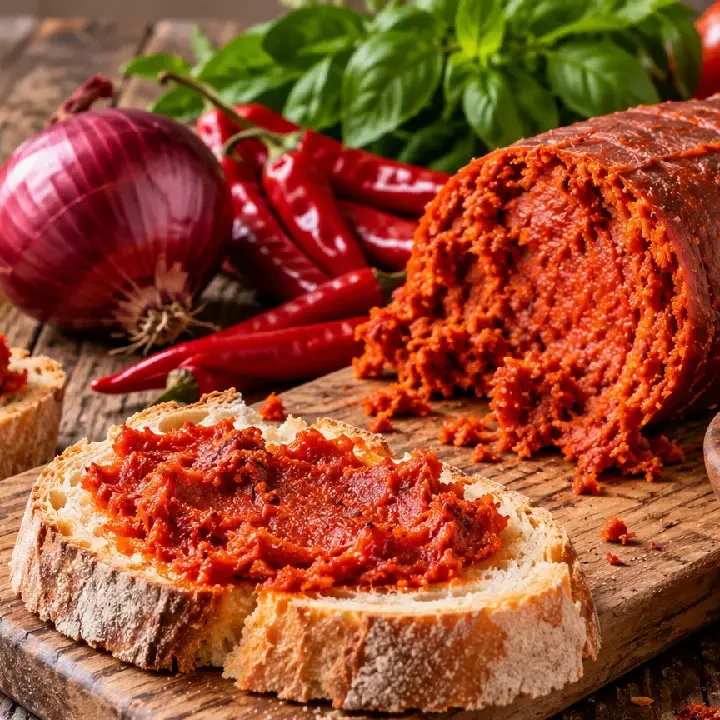
There’s a Calabrian cured meat that you don’t cut into slices. You spread it on bread, melt it into a sauce, and even a small amount can change the flavour of a dish. It’s called ’nduja, and it’s easy to recognise by its deep red colour, soft texture and unmistakable chilli heat.
Its name is closely associated with Spilinga, a village in the province of Vibo Valentia, on the slopes of Monte Poro. From here, ’nduja spread across Calabria before finding its way into restaurants throughout Italy and abroad. Long before it became so widely known, however, it belonged to the world of traditional rural charcuterie.
What Is ’Nduja Made From?
’Nduja is a soft, spreadable cured pork sausage made with pork, pork fat, Calabrian chilli peppers and salt.
Its texture comes from the finely minced meat and generous proportion of fat, while its distinctive red colour comes from the chilli peppers mixed into the meat. The chilli does more than provide heat: it also contributes to the aroma and flavour.
Traditionally, the meat is minced and mixed with chilli peppers and salt before being stuffed into a natural casing. When the pig’s caecum is used, the casing is often known locally as an orba. The sausage is then left to mature and, depending on the producer’s method, may also be lightly smoked.
The proportions vary from one producer to another. Some versions are particularly fiery, while others have a softer, fattier texture and a more noticeable pork flavour.
Why Is ’Nduja Associated with Spilinga?
In Spilinga, preserving pork has long been part of local food traditions. As in many rural communities across southern Italy, slaughtering a pig was an important occasion, and almost every part of the animal had a purpose.
’Nduja belongs to this tradition of making use of the whole animal, although accounts of its original ingredients differ. Some descriptions refer generally to leftover cuts from butchering, while local accounts suggest that ’nduja from Spilinga was traditionally made mainly with fatty trimmings and parts of the pig’s head, rather than offal.
The origin of its name is another intriguing question. One widely repeated theory connects it to the French word andouille, which refers to certain types of sausage. This has given rise to stories suggesting that ’nduja arrived in Calabria during the Napoleonic period, sometimes linking its introduction to Joachim Murat.
The similarity between the names is interesting, but it doesn’t prove that ’nduja originated at that time. Its early history remains difficult to establish with certainty, while its connection with Spilinga is still evident in the village’s local production.
How Do You Use ’Nduja in Cooking?
The simplest way to enjoy ’nduja is to spread a little on a slice of warm, crusty bread. The heat softens the fat, making it easier to spread. If you’ve never tasted it before, this is also a good way to discover just how spicy it is before adding it to a recipe.
In a pan, ’nduja melts easily, especially when added to a sauce that’s already warm. Keep the heat low and stir for a few minutes. There’s no need to fry it for long, as the chilli can burn and develop a bitter aftertaste.
In Pasta Sauces
Tomatoes and ’nduja work particularly well together. The heat of the sausage blends with the sweetness of the tomatoes, especially when the sauce also contains onion that has been gently softened in olive oil.
In Calabria, this sauce is often served with Fileja alla ’nduja, a traditional pasta shape formed by rolling the dough around a thin metal rod. Its twisted shape catches the sauce, although other pasta shapes, from penne to rigatoni, work well too.
If you’re making an ’nduja pasta sauce for the first time, start with a couple of spoonfuls and taste before adding more. Some varieties are considerably hotter than you might expect.
On Pizza, Focaccia and Bruschetta
For pizza, scatter small pieces of ’nduja between the mozzarella. As the pizza bakes, the sausage softens and releases some of its fat, creating those characteristic red patches across the surface.
Bruschetta is even simpler: toasted bread, a thin layer of ’nduja and, if you like, a little fresh cheese. Freshly baked focaccia is another excellent option, particularly when it has a crisp crust and a soft, airy centre.
With Beans, Vegetables and Eggs
A pan of beans cooked with tomatoes and onions can take on a completely different flavour with the addition of a teaspoon of ’nduja. The same works with chickpeas, especially when they’re left to simmer gently in their cooking liquid.
Potatoes are another good match. Try melting a little ’nduja in a pan before adding boiled potatoes cut into chunks. Some cooks also add it to scrambled eggs, allowing the sausage to soften in the pan before pouring in the beaten eggs.
How to Choose Good ’Nduja
Traditional ’nduja has a soft texture that makes it easy to spread. Its colour can range from bright red to darker shades, depending on the chilli peppers used and the length of maturation.
When buying it, take a look at the ingredients. The simplest versions contain pork, pork fat, chilli peppers and salt. The proportions vary, as does the flavour, so it’s worth trying different producers to discover which style you prefer.
’Nduja is sold in its casing, in vacuum-packed portions or in jars. Jars are convenient if you only use a little at a time, but it’s worth distinguishing traditional ’nduja from ’nduja-based spreads, which may also contain oil and other ingredients.
How to Store ’Nduja After Opening
Once opened, ’nduja should generally be kept in the refrigerator, well covered to prevent the exposed surface from drying out.
If you’ve bought it in its casing, carefully cover the cut end. Jarred ’nduja is easier to put away: close the lid tightly and always use a clean spoon.
For how long it can be kept, check the producer’s storage instructions. A matured ’nduja sausage in its casing and an ’nduja-based spread in a jar may have very different storage times.
Is ’Nduja Always Very Spicy?
Chilli peppers are one of the essential ingredients in ’nduja, but the level of heat can vary considerably. It depends on the variety of chilli, how much is used and the proportion of pork fat in the mixture.
If you enjoy spicy food, try spreading it directly onto bread or adding it to pizza. For a milder introduction, melt a teaspoon into a tomato sauce and add more after tasting.
You don’t need an elaborate recipe to appreciate it. Sometimes all it takes is a slice of warm bread and a knife.