Bagna càuda is not something you eat in a hurry. It arrives at the table warm, surrounded by raw and cooked vegetables, with everyone choosing what to dip into the sauce. In Piedmont, northern Italy, it is the kind of meal that encourages people to linger around the table, especially when the weather turns cold.
The recipe calls for just a few ingredients, but getting the balance between garlic, anchovies and extra virgin olive oil right is essential. The garlic cooks gently without browning, while the anchovies gradually dissolve into the oil. The result is a richly flavoured sauce that pairs particularly well with cardoons, peppers, Jerusalem artichokes and other seasonal vegetables.
For this version, we follow the recipe registered in 2005 by the Italian Academy of Cuisine (Accademia Italiana della Cucina), keeping to the traditional preparation without adding milk or cream.
Bagna càuda – Piedmontese Garlic and Anchovy Sauce
Description
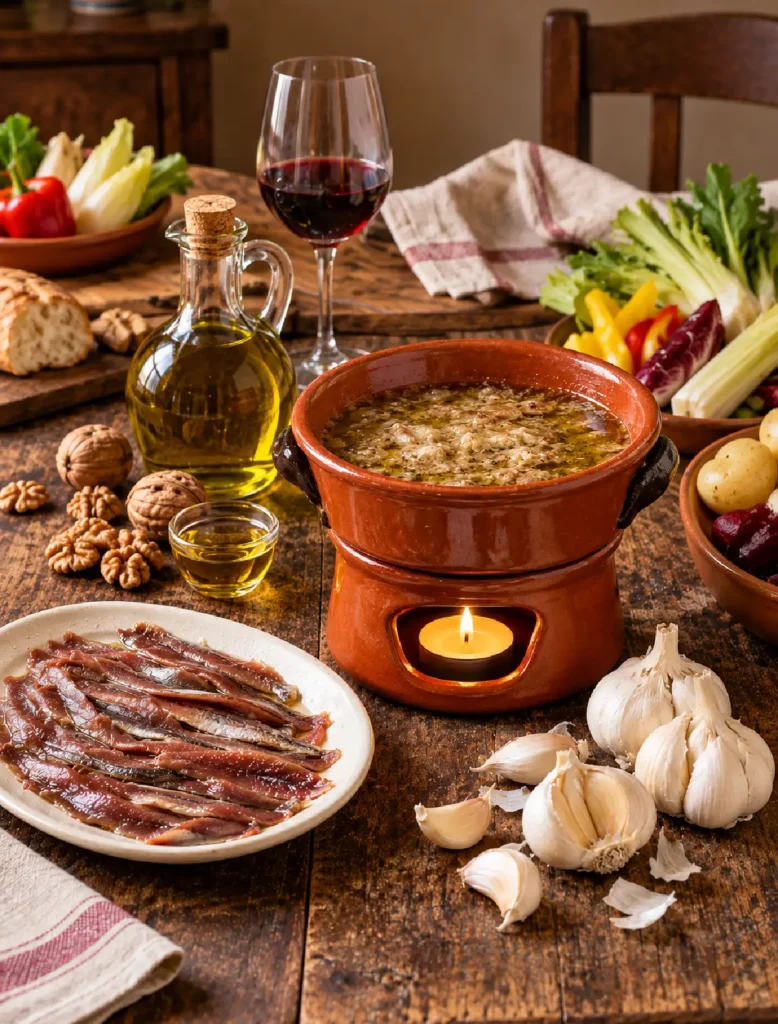
Bagna càuda is a warm Piedmontese sauce made with garlic, salt-packed anchovies and olive oil. Traditionally served in small terracotta warmers called fujot, it is enjoyed with raw and cooked vegetables.
Ingredients
Instructions
How to Make Bagna càuda
-
Desalt and clean the anchovies 🐟
Rinse the salt-packed anchovies to remove the surface salt, then place them in a bowl and cover with cold water. Leave to soak for about 2–3 hours, changing the water several times. Drain, gently open the anchovies and remove the central bones and any remaining innards. Rinse again, then transfer them to a bowl with 100 g (3.5 fl oz) of Barbera red wine and gently move them around to rinse. Drain and pat dry with kitchen paper.
-
Prepare the garlic 🧄
Separate the cloves from the 4 heads of garlic and peel them. Cut each clove in half lengthwise, remove the central green shoot if present, and slice the garlic thinly. Try to keep the slices a similar thickness so they cook evenly.
-
Start cooking the garlic 🫒
Place the garlic in a terracotta cooking pot, preferably over a heat diffuser, or use a heavy-bottomed saucepan. Add 100 g of extra virgin olive oil, taken from the total 300 g. Heat over the lowest possible heat, stirring frequently with a wooden spoon. Cook for about 10–15 minutes, until the garlic begins to soften, without allowing it to fry or brown.
-
Add the anchovies 🐟
Once the garlic starts to soften, add the cleaned and dried anchovies. Stir gently over very low heat until the anchovies begin to dissolve into the oil.
-
Finish the Bagna càuda 🥄
Pour in the remaining 200 g of extra virgin olive oil and continue cooking over very low heat for about 30 minutes, stirring occasionally. The garlic should become very tender and the anchovies should break down into the sauce. The oil must never fry: if you notice vigorous bubbling, reduce the heat further or briefly lift the pot off the heat.
-
Add the walnut oil (optional) 🌰
If using it, stir in the 15 g of walnut oil towards the end of cooking. There is no need to add salt, as the anchovies already provide plenty of seasoning.
-
Serve the Bagna càuda 🍲
Transfer the sauce to traditional fujot, small terracotta warmers that keep it hot throughout the meal. Serve with raw and cooked vegetables such as cardoons, Jerusalem artichokes, peppers, potatoes and beetroot. Keep the Bagna càuda warm without allowing it to boil.
Nutrition Facts
Servings 4
- Amount Per Serving
- Calories 875kcal
- % Daily Value *
- Total Fat 78g120%
- Saturated Fat 11g56%
- Sodium 1500mg63%
- Total Carbohydrate 17g6%
- Dietary Fiber 1.1g5%
- Sugars 0.5g
- Protein 14g29%
* Percent Daily Values are based on a 2,000 calorie diet. Your daily value may be higher or lower depending on your calorie needs.
Note
The anchovies: soaking is important to prevent the Bagna càuda from becoming overly salty. Change the water several times and handle the fillets gently when removing the bones. Rinsing them in Barbera wine afterwards follows the procedure of the registered recipe.
Cooking: keep the heat extremely low throughout. The garlic should soften without browning, and the anchovies should gradually dissolve. If using a terracotta pot on the hob, make sure it is suitable for direct heat and use a heat diffuser when necessary.
The vegetables: Bagna càuda can be served with Nizza Monferrato cardoons, Jerusalem artichokes, raw or roasted peppers, boiled potatoes, cooked beetroot and roasted onions. Raw spring onions dipped in Barbera wine are another traditional accompaniment. For more ideas on which vegetables to choose and how to prepare them, read our guide Vegetables for Bagna càuda: Which Ones to Choose?.
Variations: some versions cook the garlic in milk to produce a milder flavour. This recipe follows the preparation registered in 2005, without milk or cream. The original formulation also allows for an optional small piece of fresh butter to be added at the end of cooking.
Storage: allow the sauce to cool quickly, then transfer it to a clean, sealed container. Refrigerate promptly and preferably consume within 24 hours. Because it contains garlic in oil, do not leave it at room temperature or store it for extended periods. Reheat gently before serving.