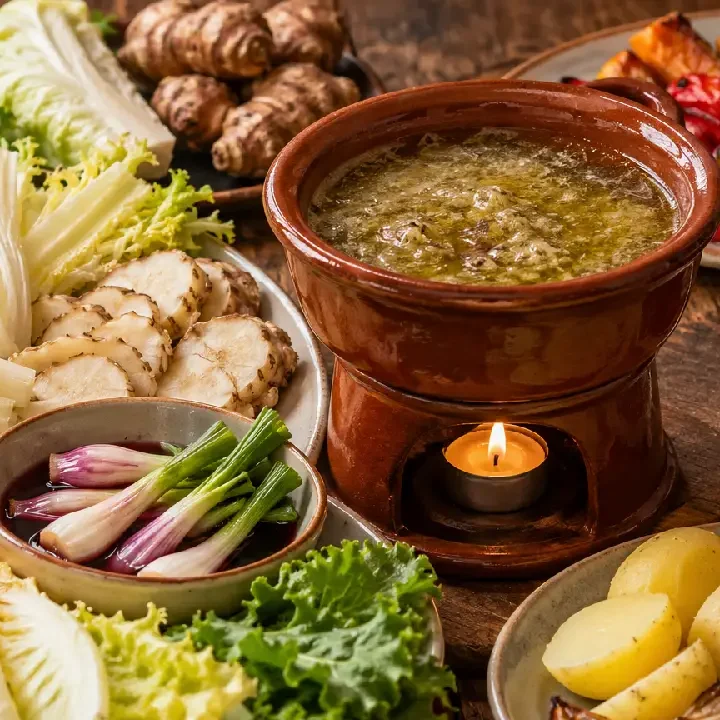
It’s hard to imagine Bagna càuda without vegetables. The sauce arrives at the table warm, in traditional terracotta pots called fujot, but it’s the vegetables that make the meal complete. Some people start with cardoons, others prefer a boiled potato, while others save the roasted peppers for scooping up the very last of the sauce.
In Piedmont, the choice is wide and largely follows the colder seasons. Alongside familiar vegetables, there are local specialties such as the cardo gobbo di Nizza Monferrato, a distinctive variety of cardoon, and lesser-known preparations such as peperoni sotto graspa, peppers preserved in grape pomace.
There’s no need to serve every vegetable on the list. Part of the pleasure lies in combining different flavours and textures, letting everyone choose their favourites.
Traditional Raw Vegetables for Bagna càuda
Cardo gobbo di Nizza Monferrato
If there’s one vegetable more closely associated with Bagna càuda than any other, it’s the cardo gobbo di Nizza Monferrato, the distinctive curved cardoon grown around Nizza Monferrato.
Cultivated in the Asti area, it takes its name from the curved shape it develops as it grows. Its stalks become tender, pale and less bitter than those of many other cardoon varieties, making them suitable for eating raw.
Before serving, the tougher outer parts and fibrous strings are removed. Once cut, the stalks can be briefly placed in water with a little lemon juice to prevent discolouration. They should then be drained and dried thoroughly, as excess water would dilute the sauce.
Its delicate flavour, with a slight bitter note, pairs particularly well with garlic and anchovies.
Jerusalem Artichokes and White Cabbage
Jerusalem artichokes are another classic accompaniment. Known in Piedmont as ciapinabò, these knobbly tubers have a crisp texture and a flavour reminiscent of artichokes.
They’re eaten raw, cut into slices that aren’t too thick. Their thin skin can be left on, provided the tubers have been thoroughly washed and scrubbed.
Another traditional choice is the heart of white cabbage, prized for its tender, crunchy inner leaves. Small wedges or compact leaves work particularly well, as they’re firm enough to dip into the Bagna càuda without falling apart.
The two vegetables are quite different, but both stand up well to the sauce’s strong flavour without being overwhelmed by it.
Endive, Escarole and Fresh Peppers
Endive and escarole bring a fresher, slightly bitter note to the table. Their tender inner leaves, carefully washed and dried, are especially good dipped into the warm sauce.
With fresh peppers, sweetness comes into play. Ripe, fleshy peppers cut into wide strips provide a clear contrast to the saltiness of the anchovies.
Traditional accompaniments also include peperoni sotto graspa, peppers preserved in grape pomace according to old Piedmontese country traditions. Their sharper, tangier flavour is quite different from that of fresh peppers and adds another dimension to the meal.
Spring Onions in Barbera Wine
One of the more unusual accompaniments is raw spring onions, quartered and soaked in Barbera red wine.
The wine complements the pungency of the onions, while the Bagna càuda adds its own intensity. It’s certainly not the mildest combination on the table, but it belongs to a straightforward style of Piedmontese cooking where garlic, wine and seasonal vegetables sit happily together without much ceremony.
Cooked Vegetables: Sweetness and Tenderness
While raw vegetables bring freshness and crunch, cooked vegetables make Bagna càuda even more satisfying.
Boiled potatoes are perhaps the simplest accompaniment. Their soft flesh absorbs the sauce beautifully and slightly mellows its intensity. They’re particularly good served warm, cut into pieces large enough to hold their shape.
Cooked beetroot adds an earthy sweetness and a vivid splash of colour. It can be served in slices or wedges, preferably well drained.
Then there are roasted onions. As they cook, they lose some of their sharpness and become soft, almost creamy. Once ready, they only need to be cut into wedges and brought to the table while still warm.
Fried Pumpkin and Roasted Peppers
Fried pumpkin is one of the accompaniments that may surprise anyone familiar only with the more common Bagna càuda combinations.
Its sweetness works well with the saltiness of the sauce, while the lightly golden surface adds a different texture from boiled vegetables. It’s best served freshly cooked, after draining away any excess oil.
Roasted peppers, meanwhile, are a much-loved favourite. Roasting concentrates their flavour and softens the flesh, making them ideal for scooping up the Bagna càuda. Once the skin and seeds have been removed, they’re cut into wide strips and served without dressings that might overpower the sauce.
How to Choose Vegetables for the Table
Tradition offers plenty of possibilities, but there’s no need to prepare every accompaniment to enjoy a good Bagna càuda.
A well-balanced selection might include raw cardoons or Jerusalem artichokes, a few strips of fresh pepper, boiled potatoes and roasted peppers. Depending on what’s available, you could add beetroot, roasted onions or other seasonal vegetables.
It’s worth paying a little attention to how everything is served. Raw vegetables should be thoroughly dried, cooked ones shouldn’t be too watery, and everything should be cut into pieces that are easy to dip.
Arranging the vegetables on separate plates makes it easier for everyone to see what’s available and choose what they like. In the centre of the table, or in front of each guest, the traditional fujot keep the sauce warm with a small flame underneath.
The Bagna càuda should stay warm without frying or boiling.
To make the sauce itself, follow our Bagna càuda recipe, based on the preparation registered in 2005 by the Italian Academy of Cuisine (Accademia Italiana della Cucina).
And Finally, the Egg
Piedmontese tradition has one last pleasure in store for anyone in no hurry to leave the table.
When the vegetables are almost finished and only the thickest part of the sauce remains at the bottom of the fujot, known as “spesso della bagna”, an egg is cracked directly into the pot.
The gentle heat allows it to scramble slowly, mixing with the remaining garlic, anchovies and olive oil. The egg blends into the sauce, becoming soft and creamy while absorbing all its flavour.
It’s a simple ending, born from the habit of wasting nothing. And perhaps it’s also the best way to understand why, in Piedmont, Bagna càuda is much more than a sauce served with vegetables.