A soup you can cut into slices? That’s one of the unusual features of Batulla, a rustic dish shared by several villages in the upper Orba Valley, in the Ligurian hinterland. From Tiglieto to Acquabianca, this speciality is also known as bacchezulla and is made with dried borlotti beans, Swiss chard, lard and, in some versions, potatoes.
What sets it apart from an ordinary soup is the white wheat flour, stirred into the mixture as it cooks until it becomes thick enough to be turned out onto a large wooden board. Once set, Batulla can be cut into slices, much like polenta.
It can be served with fresh cream or a sauce. And if there’s any left over, the slices can be fried the following day and served with cheese.
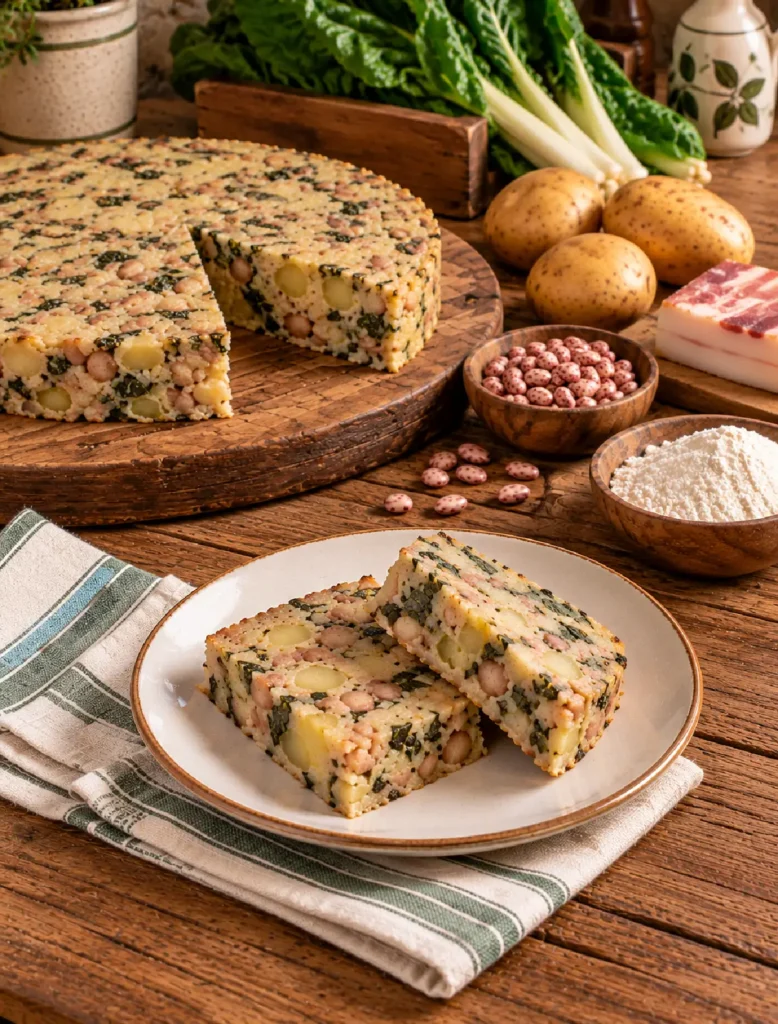
Batulla dell’Alta Valle dell’Orba, Ligurian Bean and Vegetable Polenta
Description
A traditional dish from inland Liguria, made with dried borlotti beans, potatoes, Swiss chard and lard, slowly cooked and thickened with white wheat flour until firm enough to slice.
Ingredienti
Instructions
How to Make Batulla dell'Alta Valle dell'Orba
-
Soak the beans 🫘
The evening before, place 250 g of dried borlotti beans in a large bowl and cover generously with cold water. Leave to soak for about 12 hours. The following day, drain the beans, discard the soaking water and rinse thoroughly.
-
Prepare the vegetables 🥔
Peel 400 g of potatoes and cut them into pieces about 3 cm (1.2 inches) across. Wash 250 g of Swiss chard thoroughly to remove any traces of soil. Chop the tender stalks into small pieces and roughly cut the leaves, discarding only the toughest parts. Cut 60 g of lard into small pieces.
-
Start cooking 🍲
Place the drained beans, potatoes, Swiss chard and lard in a large, heavy-based pot. Add 1500 g of cold water, gradually bring to a boil, then reduce the heat. Partially cover with a lid and leave to simmer gently.
-
Cook slowly 🥄
Continue cooking for about 3 hours, stirring occasionally and checking the liquid level. If the mixture begins to dry out, add a little hot water at a time.
Towards the end of cooking, season with coarse salt to taste. The beans should be extremely tender, and the potatoes should have partially broken down. If too much liquid remains, remove the lid and cook for a few more minutes to allow the excess water to evaporate. The mixture should resemble a thick, soft soup rather than a watery broth.
-
Add the flour 🌾
Keep the pot over low heat and gradually add 150 g of type 0 wheat flour, sprinkling it in while stirring vigorously with a wooden spoon.
Add the flour in several batches, making sure each addition is fully incorporated before adding more. Stir right across the bottom of the pot, where the mixture will become increasingly likely to stick as it thickens.
-
Cook until thick 🥣
Continue cooking over low heat for approximately 15–20 minutes, stirring frequently, until the flour is cooked through and the mixture becomes very thick.
Batulla is ready when the spoon leaves a clearly visible groove and the mixture moves slowly without immediately settling back into place. It should be firm but neither dry nor hard, as it will become more compact while cooling.
-
Transfer and leave to set 🪵
While still hot, transfer the Batulla onto a large, clean wooden board or into a wide, shallow dish. Spread it with the back of a spoon to form a layer approximately 3–4 cm (1.2–1.6 inches) thick.
Allow it to cool slightly, then cover and refrigerate once it is no longer hot. Leave it to set for several hours, preferably overnight, especially if you want neatly defined slices. Do not leave it at room temperature for more than two hours.
-
Slice and serve 🍽️
Once completely set, cut the Batulla into slices approximately 2 cm (0.8 inches) thick. Serve with fresh cream or a sauce, according to local custom.
Nutrition Facts
Servings 4
- Amount Per Serving
- Calories 600kcal
- % Daily Value *
- Total Fat 17g27%
- Saturated Fat 6g30%
- Sodium 400mg17%
- Total Carbohydrate 88g30%
- Dietary Fiber 15g60%
- Sugars 6g
- Protein 24g48%
* Percent Daily Values are based on a 2,000 calorie diet. Your daily value may be higher or lower depending on your calorie needs.
Note
Fried Batulla: Once completely cooled and set, preferably after a night in the refrigerator, Batulla can be cut into slices about 2 cm (0.8 inches) thick and fried in a pan with a little additional lard or extra virgin olive oil. Cook for approximately 3–4 minutes on each side, turning carefully, until a crisp, golden crust forms. Serve hot, with cheese if desired.
Getting the consistency right: The amount of water is approximate. You may need to add more during the long cooking process, but the mixture should not be overly liquid before the flour is incorporated. Batulla needs to be firm enough to set and hold its shape when sliced, without becoming excessively hard.
Storage: Allow the Batulla to cool and refrigerate it within two hours of cooking, in a covered container. It will keep for 2–3 days. Fried slices are best eaten immediately, while the outside is still crisp.