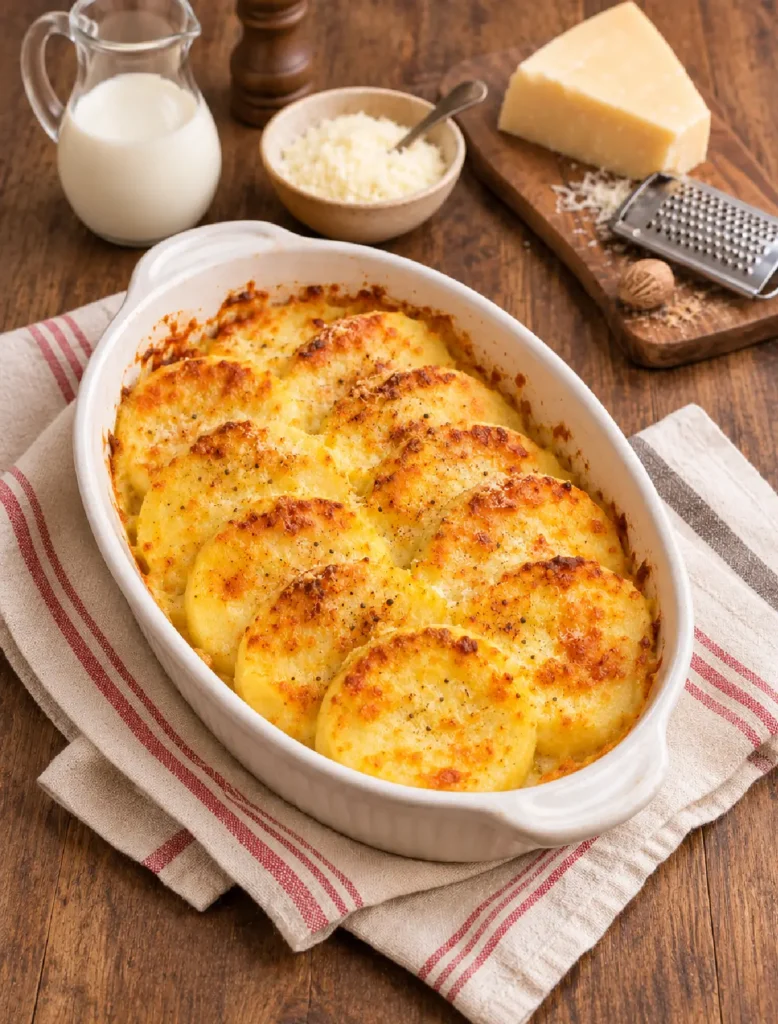
Gnocchi alla Romana have little in common with potato gnocchi. There’s no dough to knead on a work surface, and they never go into a pot of boiling water. Instead, they’re made from semolina cooked in milk, shaped into rounds and baked with butter and Parmesan. A thin golden crust forms on top, while the centre stays soft, with a hint of nutmeg.
Cooking the semolina is the part that needs the most attention. We pour it into hot milk and keep stirring as it thickens, making sure no lumps form. Once it’s ready, we stir in the egg yolks and Parmesan, spread the mixture out and leave it to cool. Only then can we cut it into rounds. We arrange them in a baking dish, each one slightly overlapping the next, and finish with the remaining butter and cheese. In the oven, the edges begin to brown before the centres, until the tops turn golden too.
In Rome, semolina gnocchi belong to a culinary tradition recorded in generations of cookbooks, although historical versions weren’t always the same as the dish we know today. It’s also a recipe we can prepare ahead: the rounds can be made a few hours in advance and kept in the refrigerator. We prefer to leave the final baking until just before serving.
Gnocchi alla Romana with Semolina and Parmesan
Description
A traditional Roman dish made with semolina, milk, egg yolks and Parmesan. The cooked semolina is cut into rounds, arranged in a baking dish and baked with butter and cheese until golden on top and soft inside.
Ingredients
For the gnocchi
For the gratin
Instructions
How to Make Gnocchi alla Romana
-
Heat the milk 🥛
Pour 1 litre (approximately 34 US fl oz) of whole milk into a large saucepan. Add salt, a little freshly ground black pepper and a pinch of nutmeg. Heat over medium heat until the milk is just about to boil, then gradually sprinkle in the 250 g (8.8 oz) of semolina, whisking continuously to prevent lumps.
-
Cook the semolina 🥄
Reduce the heat and keep stirring. Once the mixture becomes too thick for the whisk, switch to a wooden spoon or heat-resistant spatula. Cook for approximately 10–15 minutes, stirring frequently, until the semolina resembles very thick polenta and begins to pull away from the sides of the saucepan.
-
Add the butter, egg yolks and Parmesan 🧈
Remove the saucepan from the heat and stir in 50 g (1.8 oz) of butter, cut into small pieces. Add the 2 egg yolks, one at a time, stirring quickly so they incorporate without scrambling in the hot semolina. Finally, add 100 g (3.5 oz) of grated Parmigiano Reggiano and mix until evenly combined.
-
Spread and cool the mixture ❄️
Immediately transfer the semolina mixture to a baking tray lined with baking parchment. Using a spatula lightly moistened with water, spread it into an even layer approximately 1.5 cm (⅝ inch) thick. Leave to cool slightly, then allow it to cool completely, refrigerating for 30–40 minutes if necessary, until firm enough to cut without losing its shape.
-
Cut out the gnocchi ⭕
Using a round cutter approximately 5 cm (2 inches) in diameter, cut the semolina into discs. If the mixture sticks, lightly moisten the edge of the cutter with water. Keep the trimmings, as they can be arranged at the bottom of the baking dish without kneading them together again.
-
Arrange the gnocchi in the baking dish 🧀
Melt the remaining 40 g (1.4 oz) of butter and use a little to grease the baking dish. Arrange any semolina trimmings on the bottom, then place the rounds on top in slightly overlapping rows. Drizzle with the remaining melted butter and sprinkle evenly with 40 g (1.4 oz) of grated Parmigiano Reggiano.
-
Bake until golden 🔥
Bake in a preheated conventional oven at 180°C (350°F) for approximately 15 minutes on the middle shelf. Switch to the grill (broiler) and cook for another 3–5 minutes, watching carefully to prevent the cheese from burning. Once the gnocchi are hot throughout and golden on top, remove them from the oven and leave to rest for a couple of minutes before serving.
Nutrition Facts
Servings 6
- Amount Per Serving
- Calories 440kcal
- % Daily Value *
- Total Fat 24g37%
- Saturated Fat 14g70%
- Sodium 360mg15%
- Total Carbohydrate 37g13%
- Dietary Fiber 1.5g6%
- Sugars 9g
- Protein 18g36%
* Percent Daily Values are based on a 2,000 calorie diet. Your daily value may be higher or lower depending on your calorie needs.
Note
Storage
Cooked Gnocchi alla Romana can be kept in an airtight container in the refrigerator for up to 2 days. Reheat in the oven at 170–180°C (340–355°F) until thoroughly heated. If the tops are already well browned, cover loosely with foil for the first part of reheating.
Make ahead
We can prepare the semolina rounds the day before, arrange them in the baking dish and refrigerate them, well covered. Add the butter and Parmesan for the gratin just before baking.
Freezing
The uncooked rounds can be frozen before baking. Arrange them in layers separated by baking parchment, then transfer to a freezer-safe container once firm. For best quality, use within one month. Thaw in the refrigerator before assembling and baking.
Choosing semolina
Use fine durum wheat semolina, not coarse semolina or the coarser durum wheat flour commonly sold for bread and pasta. In international shops, look for products labelled fine durum wheat semolina or fine semolina.
Fan-assisted oven
Bake at 160–170°C (320–340°F), checking after approximately 15 minutes. If needed, finish briefly under the grill (broiler) to brown the surface.