Flour on the pasta board, eggs in the centre and hands ready to knead. This is where fresh egg pasta begins, with two simple ingredients that form the basis of some of Italy’s best-known pasta dishes.
One of the most commonly used ratios for fresh egg pasta is easy to remember: one egg for every 100 g of flour. It’s a useful starting point rather than an exact formula. Eggs vary in size and different flours absorb moisture differently, so you also need to pay attention to how the dough looks and feels as you work it.
At first, the mixture may look rough and uneven. As you continue kneading, it gradually becomes firmer, smoother and more elastic. After resting, the dough will be much easier to roll out into thin pasta sheets.
There aren’t many steps involved, but learning to recognise the right consistency comes with practice.
Rolling Pasta by Hand on a Wooden Board
Rolling pasta by hand requires only a few tools: a wooden pasta board, a long rolling pin and enough room to stretch out the dough.
The flour was shaped into a well, the eggs cracked into the centre and gradually incorporated. Once the dough had been kneaded and rested, it was time to roll it out.
Rolling pasta well takes practice. The dough needs to be turned and stretched without tearing, and knowing when you’ve reached the right thickness depends on the type of pasta you’re making.
Today, a pasta machine makes the process easier and more consistent. The dough is passed through the rollers several times, gradually reducing the thickness until you reach the desired setting.
The rolling pin, however, remains closely associated with the tradition of handmade Italian pasta, particularly in Emilia-Romagna.
In Emilia-Romagna, and particularly in the Bolognese tradition, there is also the figure of the sfoglina, a traditional term for someone skilled in preparing egg pasta dough and rolling it into large sheets by hand with a rolling pin.
It’s a skill developed through practice. There isn’t one perfect thickness for every kind of pasta because the sheet needs to suit whatever it’s going to become.
One Dough, Many Different Types of Pasta
Sometimes all you need to change is the cut and thickness.
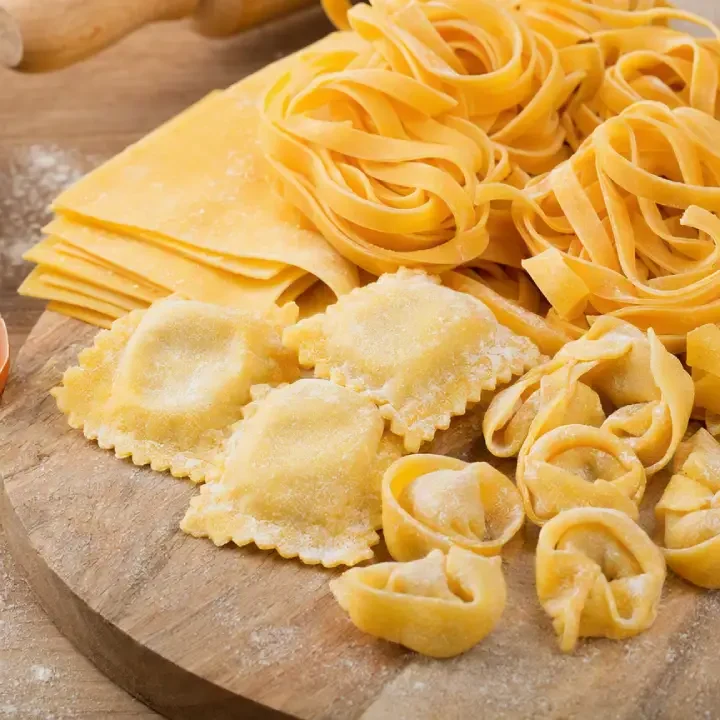
Fresh pasta sheets can be cut into tagliatelle or fettuccine, left larger for lasagne or used to make filled pasta. Even the uneven edges and scraps can be put to good use by cutting them into maltagliati.
That’s one of the great strengths of a dough made, at its most basic, from just flour and eggs: the same preparation can become many very different types of pasta.
There are also variations on classic egg pasta that incorporate additional ingredients. One of the best known is green egg pasta, made with spinach and traditionally associated with Emilia-Romagna dishes such as Lasagne alla Bolognese.
Fresh Pasta Is Something You Learn by Making It
We no longer need to make pasta from scratch every time we want to put a pasta dish on the table. Yet fresh egg pasta is still prepared in home kitchens throughout Italy.
Part of the reason is that following a recipe only teaches you so much.
After making it a few times, you start to recognise whether the dough feels too dry, whether it needs a little more kneading or whether it’s finally ready to rest. These small signs become easier to read each time you work with the dough.
The recipe gives you the quantities and the method. Your hands do the rest.
Make Fresh Egg Pasta at Home
You’ll find the complete recipe with quantities, timings and step-by-step instructions for making the dough and rolling it into pasta sheets.