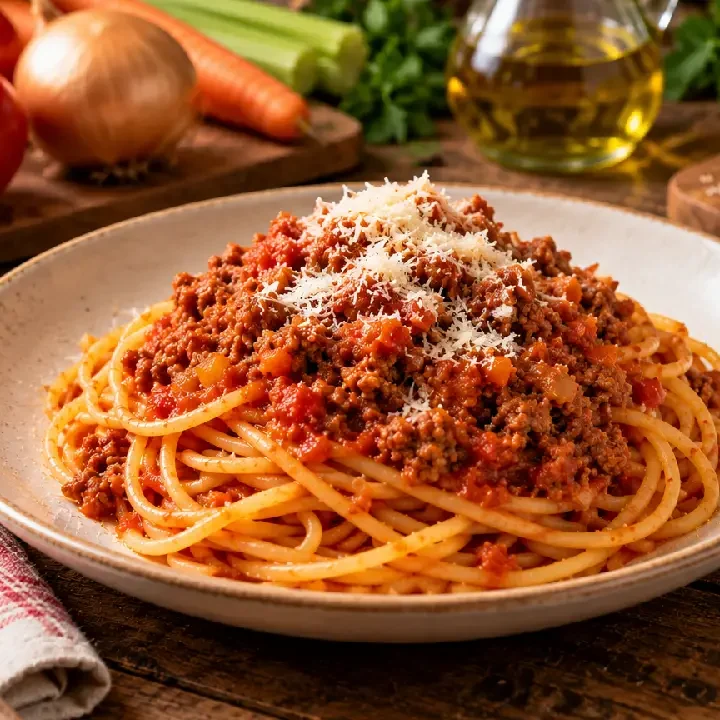
In many countries, seeing Spaghetti Bolognese on a menu gives you a pretty good idea of what to expect: spaghetti topped with a tomato and minced meat sauce, often finished with a generous sprinkling of grated cheese. In the United Kingdom, the dish is so popular that it even has its own nickname, Spag Bol, widely used in everyday conversation and home cooking.
In Bologna, however, things are rather different. Ragù is one of the city’s most celebrated culinary specialities, but its most traditional pairing is with fresh egg tagliatelle, not spaghetti.
This has led to a widespread belief that Spaghetti Bolognese must have been invented abroad, perhaps in Italian-American restaurants before becoming famous elsewhere.
Yet as early as the late nineteenth century, a hotel in Turin was already serving spaghetti alla bolognese. That historical reference makes the origins of this familiar dish far more interesting than they might first appear.
Before Spaghetti, There Was Maccheroni alla Bolognese
In 1891, Pellegrino Artusi published the first edition of La scienza in cucina e l’arte di mangiar bene (Science in the Kitchen and the Art of Eating Well), one of the most influential cookbooks in Italian culinary history.
Among its recipes was Maccheroni alla bolognese, a pasta dish dressed with a meat sauce that shared some characteristics with modern ragù, but also differed from it in important ways.
Artusi used veal, pancetta, butter and aromatics. There was no tomato, an ingredient now considered almost essential in many versions of Bolognese sauce. His recipe was intended for macaroni, although he also mentioned tagliatelle as a possible alternative.
This was not yet the ragù alla bolognese we know today. Over time, the preparation would incorporate new ingredients and changing proportions of meat, vegetables and tomato. The choice of pasta was not as firmly established either.
Bologna already enjoyed a considerable gastronomic reputation. As food historian Luca Cesari points out, long before ragù became famous abroad, products such as mortadella and other cured meats from Bologna were known across Europe and in the United States. The expression alla bolognese suggested a rich style of cooking, particularly associated with meat dishes.
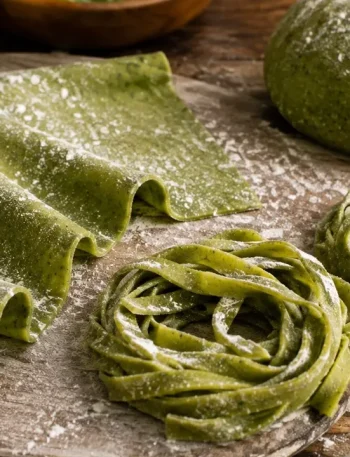
It did not always refer to the same sauce. Some nineteenth-century cookbooks and early twentieth-century American recipes, for example, featured pasta alla bolognese prepared with spinach and meat sauce, quite unlike the tomato-based spaghetti dish familiar today.
Spaghetti Bolognese Appeared in Turin in 1898
On 22 April 1898, the Italian newspaper La Stampa published an advertisement for the Hôtel Ville et Bologne in Turin. Its menu included a dish called Spaghetti di Napoli alla bolognese, meaning Neapolitan spaghetti prepared in the Bolognese style.
Food historian Massimo Montanari has drawn attention to this reference, placing it within the context of late nineteenth-century Italy.
Turin had been the first capital of the Kingdom of Italy, and bringing together Neapolitan spaghetti and a Bolognese-style sauce on the same plate could have symbolised the meeting of different regional culinary traditions.
It is an intriguing interpretation, although it remains just that: a historical interpretation. The advertisement does not provide a recipe, so we cannot know exactly how the sauce was prepared or whether it resembled modern Spaghetti Bolognese.
What the evidence does establish is that spaghetti were already being associated with the Bolognese name in Italy in 1898, well before the dish became internationally famous.
Nor was this an isolated reference. On 17 December 1910, spaghetti alla bolognese appeared again in Turin, this time at the Ristorante della Zecca. According to Montanari’s research, the dish subsequently began to spread beyond more affluent dining establishments and eventually reached other parts of Italy.
These records do not tell us who first invented the recipe. They do, however, make it difficult to argue that the idea of serving spaghetti with a Bolognese-style sauce originated exclusively in the United States.
From Italy to America: Cookbooks and Italian Emigration
By the early twentieth century, spaghetti were already familiar in the United States, particularly within Italian immigrant communities. Dried pasta was easier to store, transport and sell than fresh egg tagliatelle, which required a different method of preparation.
In 1917, Julia Lovejoy Cuniberti published Practical Italian Recipes for American Kitchens, a cookbook aimed at American readers. Proceeds from the book helped support the families of Italian soldiers serving during the First World War.
Among its recipes was Bolognese Sauce for Macaroni, inspired by Artusi’s earlier preparation. Cuniberti suggested serving the sauce with either macaroni or spaghetti.
This shows how an Italian recipe could be introduced to American kitchens using a type of pasta that was already familiar and readily available. There was no need to invent an entirely new sauce: the pairing could simply be adapted to local eating habits.
By 1920, spaghetti alla bolognese appeared on the menu of New York’s Hotel Commodore, as documented by Luca Cesari. Massimo Montanari also identifies a reference in the Los Angeles Times in 1925.
These American records are valuable evidence of the dish’s growing popularity, but they do not necessarily establish where it originated. The expression alla bolognese had already crossed the Atlantic in several different culinary forms, some of which bore little resemblance to the ragù we recognise today.
During the 1930s and 1940s, spaghetti alla bolognese were also documented in other European countries. Their success followed no single route. Restaurants, cookbooks, migration and the availability of ingredients all helped turn an Italian preparation into an international dish.
Bologna’s Ragù Is Different from the Bolognese Sauce Known Abroad
As Spaghetti Bolognese spread internationally, the sauce changed too. In many versions, tomato became the dominant ingredient, while minced meat was cooked with onion, garlic, herbs and other additions that varied from country to country.
Traditional ragù alla bolognese follows a different approach. Meat is the central ingredient, tomato is used more sparingly, and the sauce is cooked slowly to develop a rich, concentrated flavour.
On 17 October 1982, the Italian Academy of Cuisine (Accademia Italiana della Cucina) officially registered a reference recipe with the Bologna Chamber of Commerce. More than forty years later, on 20 April 2023, the recipe was updated following further research into local culinary traditions.
The current version includes coarsely minced beef, fresh pancetta, onion, carrot, celery, white or red wine, tomato passata and tomato paste, stock and extra virgin olive oil. Whole milk is optional.
The ragù cooks for approximately two to three hours, with additional liquid added when necessary. The result is a substantial meat sauce in which the beef plays a much more important role than simply being an addition to a tomato sauce.
The Academy also acknowledges certain variations, including a mixture of beef and pork or the use of cured pancetta instead of fresh pancetta. The registered recipe provides a reference for the local tradition rather than attempting to eliminate family variations.
This is why a simple comparison between traditional ragù and international Bolognese sauce can be misleading. Not all versions prepared abroad are alike. Some remain relatively close to the Italian preparation, while others have developed quite different characteristics.
Why Is Ragù Served with Tagliatelle in Bologna?
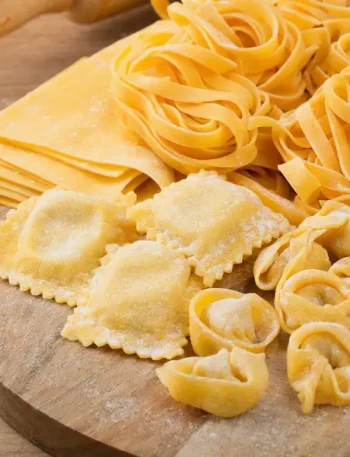
In Bolognese cooking, fresh egg tagliatelle have become the pasta most closely associated with ragù. Their slightly rough surface and broad, flat shape make them particularly suitable for holding a thick, meat-rich sauce.
Spaghetti made from durum wheat semolina have a different texture and shape. This does not mean they cannot be served with ragù, but they do not occupy the same place in Bologna’s culinary tradition.
The connection between tagliatelle and ragù has also received official recognition. In September 2022, the Municipality of Bologna included Bolognese ragù and its traditional tagliatelle among the specialities recognised under the city’s Denominazione Comunale d’Origine (De.Co.), a designation intended to protect local culinary heritage.
For visitors hoping to experience Bologna’s traditional cuisine, tagliatelle al ragù are therefore a far more representative choice than Spaghetti Bolognese.
That does not prevent restaurants or home cooks from serving ragù with other types of pasta. Culinary traditions are not fixed, and the history of ragù itself shows how recipes can evolve. But serving spaghetti with meat sauce is one thing; presenting them as the defining pasta dish of Bologna is another.
How Spaghetti Bolognese Became an International Favourite
After the Second World War, Spaghetti Bolognese became increasingly popular as pasta and commercially prepared food products became more widely available. Ready-made sauces and canned meals made the dish accessible even to people with little experience of Italian cooking.
The food industry helped spread simpler, more standardised versions. The name Bolognese remained, but the contents could differ considerably from the ragù prepared in Bologna’s homes and restaurants.
The dish became particularly popular in the United Kingdom, where it gradually established itself as a familiar home-cooked meal.
Its place in British eating habits is documented in a study published in the Journal of Foodservice in 2006, examining how dishes of foreign origin had become part of local food culture.
The study refers to a 2003 BBC survey in which Spaghetti Bolognese ranked first among respondents’ favourite dishes, ahead of curry and rice.
For many British families, it was no longer an unfamiliar Italian speciality to order at a restaurant. It had become an ordinary dinner prepared at home.
Something similar happened in Australia and other countries, where Spaghetti Bolognese became an everyday meal, with ingredients and cooking methods adapted to local tastes.
The name still points to Bologna, but the recipe has developed different identities depending on where it is cooked.
So, Are Spaghetti Bolognese Really Italian?
Ragù alla bolognese belongs to Italian culinary tradition, and the pairing of spaghetti with a Bolognese-style sauce was documented in Italy as early as the late nineteenth century. It would therefore be inaccurate to dismiss Spaghetti Bolognese as simply an American invention.
At the same time, the dish now known around the world does not necessarily correspond to a traditional recipe from Bologna. Its international popularity has changed ingredients, proportions and eating habits, producing numerous interpretations.
We cannot confidently attribute its invention to Turin, Italian immigrants in the United States or any single restaurant owner. The available historical evidence points to a more complex development, in which regional cooking traditions, dried pasta and meat sauces came together in different settings.
In Bologna, meanwhile, tagliatelle al ragù have retained their place in the city’s culinary identity.
Spaghetti Bolognese took another path. Rooted in Italian ingredients and culinary traditions, they crossed borders and generations, eventually becoming a dish that millions of people recognise and prepare in their own way.
A dish that carries Bologna in its name, but whose history extends far beyond the city itself.