When we prepare a plate of pasta, a handful of grated cheese is often all it takes to finish the dish. Parmigiano Reggiano, Grana Padano and Pecorino are among the most familiar names in Italian cooking, but their differences are not always obvious.
Parmigiano Reggiano and Grana Padano can look almost identical, especially once grated. Pecorino, on the other hand, is often associated with the strong, salty flavor we know from carbonara or cacio e pepe. Yet some Pecorino cheeses are fresh and mild, quite unlike aged Pecorino Romano.
The first difference is the milk. Parmigiano Reggiano and Grana Padano are made from cow’s milk, while Pecorino cheeses are made from sheep’s milk. Their production regions, methods, aging periods and flavors also vary.
There is another important distinction. Parmigiano Reggiano and Grana Padano are two specific PDO cheeses, while Pecorino refers to an entire family of cheeses, including numerous regional varieties. Understanding these differences helps us make better choices when shopping and explains why certain Italian recipes call for a particular cheese.
Parmigiano Reggiano: Three Ingredients and a Long Aging Process
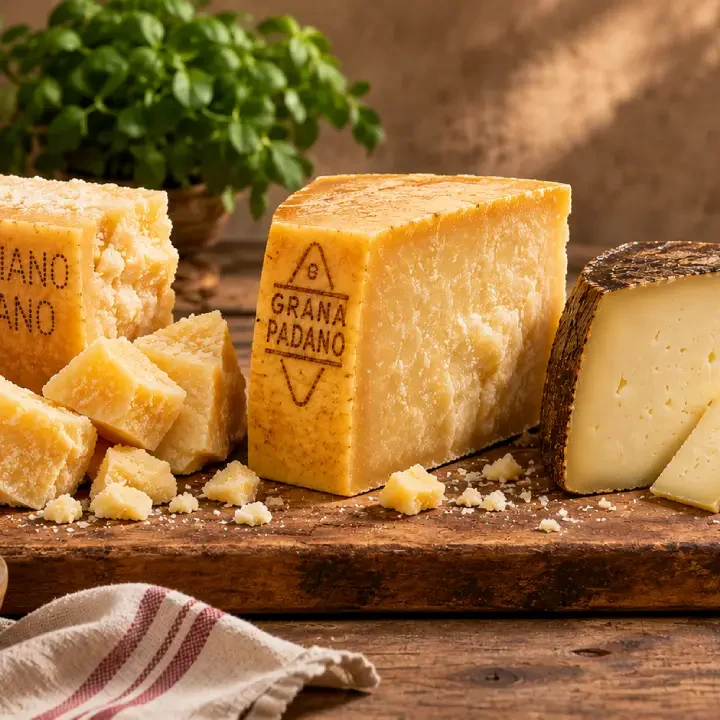
Break off a piece of aged Parmigiano Reggiano and its granular texture becomes immediately apparent. In more mature cheeses, the paste breaks into irregular flakes, while flavors reminiscent of nuts and broth develop on the palate. This comes from a production process using just milk, salt and rennet, followed by at least 12 months of aging.
Its history goes back to the Middle Ages, when producing large wheels of cheese made it possible to preserve milk for much longer periods.
Parmigiano Reggiano PDO is produced within a strictly defined area covering the provinces of Parma, Reggio Emilia and Modena, together with the parts of the province of Bologna to the left of the Reno River and the province of Mantua to the right of the Po River.
No additives or preservatives are permitted. The production rules also regulate what the cows are fed, excluding silage from their diet.
Milk from the evening milking is left to rest so that some of the cream can rise naturally to the surface. It is then combined with milk from the morning milking and processed in traditional copper vats.
The minimum aging period is 12 months, although Parmigiano Reggiano aged for 18, 24, 30 or 36 months is widely available, along with even more mature versions.
At 12–18 months, Parmigiano Reggiano retains a relatively supple texture, with aromas reminiscent of milk, butter and yogurt. By 24 months, it becomes more crumbly and granular, developing notes of nuts, broth and sometimes spices. Longer aging brings further complexity, a drier texture and often a more lingering flavor.
A 36-month Parmigiano is not necessarily the best choice for every occasion. A younger cheese may suit those looking for a milder flavor, while a longer-aged version offers different characteristics that are particularly interesting when tasting it on its own.
Grana Padano: How Is It Different from Parmigiano Reggiano?
At the cheese counter, Parmigiano Reggiano and Grana Padano can be difficult to tell apart. Both have a granular texture, are sold in large wheels and often end up grated over the same dishes. Yet their differences begin long before aging, with the cows’ diet and the way the milk is processed.
Grana Padano PDO shares its use of cow’s milk and a cheesemaking heritage rooted in the Po Valley with Parmigiano Reggiano. Its production area, however, is larger and extends across parts of several northern Italian regions.
Grana Padano is made from raw cow’s milk that has been partially skimmed through natural cream separation. Its production rules allow silage in the cows’ diet and permit the use of lysozyme, a protein extracted from egg whites that helps prevent unwanted fermentation during maturation.
Lysozyme is not used in every production. Trentingrana, for example, is made without it.
Grana Padano must be aged for at least 9 months, compared with the 12-month minimum for Parmigiano Reggiano. More mature versions are also available, including Grana Padano Riserva, aged for over 20 months.
Parmigiano Reggiano vs Grana Padano: Can You Taste the Difference?
This is probably the most interesting question, because the two cheeses can be surprisingly difficult to distinguish by appearance alone.
Young Grana Padano, generally aged between 9 and 16 months, tends to have a mild flavor, a noticeable sweetness and aromas reminiscent of milk and cream. Its texture is still relatively firm, and its flavor may linger for less time than that of more mature versions.
Young Parmigiano Reggiano, around 12–18 months old, also has sweet, milky notes, often accompanied by hints of butter and yogurt. So the idea that Parmigiano is always strong while Grana Padano is necessarily mild does not really hold up.
The differences become more interesting as the cheeses age.
At 24 months, Parmigiano Reggiano generally develops a more crumbly texture and a broader aromatic profile. Alongside its milky notes, we may recognize nuts, broth and sometimes vegetal or spicy nuances. Its flavor tends to linger longer on the palate.
Grana Padano also changes considerably. Beyond 16 months, aromas of butter, dried grass and broth become more noticeable. Grana Padano Riserva, aged for over 20 months, can develop notes of nuts and hay, with a more granular texture and a rich, lingering flavor.
A Grana Padano Riserva may taste more intense than a young Parmigiano Reggiano. Even cheeses aged for similar lengths of time can show different nuances depending on the dairy where they were made.
In general, Parmigiano Reggiano is often appreciated for the range of its aromatic notes, while Grana Padano, especially when younger, tends to have a milder, milkier character. As it matures, however, Grana Padano also gains depth and persistence.
To appreciate the differences, we can taste cheeses of comparable ages without accompaniments that might mask their flavors. A small piece of each, allowed to soften slowly in the mouth, is enough to notice differences in saltiness, aroma and texture.
Thinking of Grana Padano simply as a cheaper alternative to Parmigiano Reggiano overlooks much of what makes these two cheeses distinctive.
Pecorino: More Than One Type of Cheese
Pecorino is a little more complicated. Not because it is difficult to recognize, but because the name covers cheeses that can be remarkably different from one another.
The term refers to a family of cheeses made from sheep’s milk rather than one specific product. Italy has many varieties, each connected to its own region and cheesemaking traditions.
Some are fresh, soft and mild. Others become hard, crumbly and intensely aromatic after months of aging. Three well-known PDO varieties show just how much Pecorino can vary: Pecorino Romano, Pecorino Toscano and Pecorino Sardo.
Pecorino Romano: A Defining Flavor of Roman Cooking
Pecorino Romano PDO is probably the best-known variety internationally, largely thanks to the famous pasta dishes of Rome.
Made from whole sheep’s milk, it has a firm texture that becomes hard and granular with age. Its flavor is aromatic and salty, with a sharp, piquant character that can become more pronounced in mature cheeses.
The minimum aging period is 5 months for table cheese and 8 months for cheese intended for grating.
Despite its name, Pecorino Romano is not produced exclusively in Lazio. Its PDO production area also includes the whole of Sardinia, where a substantial share of production takes place, and the province of Grosseto in Tuscany.
Its connection with Roman cooking remains particularly strong. In carbonara, gricia and cacio e pepe, its saltiness helps define the character of the dish. It is not merely a cheese sprinkled over pasta at the end, but one of the ingredients around which the sauce is built.
Pecorino Toscano: From Fresh to Aged
Pecorino Toscano PDO is a good reminder that sheep’s milk cheese does not always have a strong flavor.
The fresh version, matured for at least 20 days, has a tender texture and a mild, sweet taste, with notes reminiscent of milk and butter. It is particularly enjoyable sliced and served with bread or vegetables.
Aged Pecorino Toscano, meanwhile, matures for at least 120 days. Its texture becomes firmer and its flavor more pronounced, although its character remains different from the typically salty profile of Pecorino Romano.
It can be served in shavings, grated over dishes or enjoyed on its own.
Pecorino Sardo: Dolce and Maturo
Aging can dramatically change the character of Pecorino Sardo PDO. The Maturo variety, aged for at least two months, has a firm texture and a flavor that gradually becomes more intense, sometimes developing piquant notes.
Pecorino Sardo Dolce shows another side of the same cheese. After 20–60 days of maturation, it retains a soft texture and a delicate flavor, with milky aromas and a slight acidity.
Both varieties are produced exclusively in Sardinia using whole sheep’s milk.
Romano, Toscano and Sardo are only a few examples. Fiore Sardo PDO, Pecorino Siciliano PDO and numerous local specialties add even more variety to Italy’s sheep’s milk cheese traditions.
Which Cheese Should You Use in Italian Recipes?
Knowing the differences is useful, but when we cook, a more practical question comes up: can we substitute one cheese for another?
Often we can, although the finished dish will taste different.
Parmigiano Reggiano and Grana Padano can serve similar purposes in many preparations. Both work well grated over pasta, mixed into fillings, stirred into risotto or used in baked dishes.
Pecorino requires a little more consideration, particularly when choosing a very mature, salty variety.
Carbonara, Gricia and Cacio e Pepe
Pecorino Romano has a particularly important place in Roman cooking.
In carbonara, it accompanies the eggs and guanciale, contributing both flavor and texture to the sauce. Some versions use Pecorino Romano exclusively, while others combine it with Parmigiano Reggiano for a less pronounced flavor.
In gricia, Pecorino combines with rendered guanciale fat and pasta cooking water. In cacio e pepe, it takes center stage alongside black pepper.
Anyone who has tried making cacio e pepe will recognize the problem: instead of a smooth, creamy sauce, the cheese forms small clumps while watery liquid remains at the bottom of the pan. This happens especially when the cheese is exposed to excessive heat. Its proteins aggregate, and once the clumps have formed, achieving a smooth sauce becomes difficult.
We can certainly prepare pasta with black pepper and Parmigiano Reggiano, but it will taste different from cacio e pepe made with Pecorino Romano. The saltiness, aromas and sometimes even the techniques needed to achieve the right consistency will change.
Pesto alla Genovese
Pesto alla genovese offers a different example, because its preparation includes two cheeses.
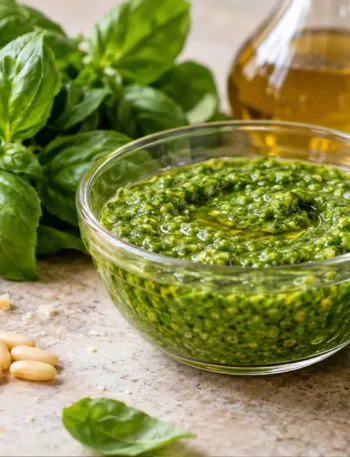
The recipe published by the Consorzio del Pesto Genovese calls for Parmigiano Reggiano PDO, with Grana Padano as an alternative, together with Pecorino PDO, specifically mentioning Fiore Sardo.
The cow’s milk cheese contributes its aromatic notes, while the sheep’s milk cheese adds a more pronounced character. Together, they complement the basil, pine nuts, garlic and extra virgin olive oil.
Changing one of the cheeses can noticeably alter the flavor of the pesto, particularly when using a strongly flavored Pecorino.
Lasagne, Risotto and Pasta Fillings
Parmigiano Reggiano is one of the characteristic ingredients in lasagne alla bolognese. It blends with the ragù and béchamel, contributing to the overall flavor without necessarily overpowering the other ingredients.
Grana Padano can be used in many similar preparations, as well as in risotto, gratins and fresh pasta fillings.
An aged Pecorino, however, can produce a much stronger result. In a delicate ricotta and spinach filling, for example, a particularly salty cheese could mask some of the other flavors.
For a simple plate of pasta with tomato sauce, we can choose Parmigiano Reggiano, Grana Padano or a Pecorino suitable for grating. But when preparing a regional recipe with a well-established combination of ingredients, it is worth using the specified cheese, at least the first time.
How to Recognize Authentic PDO Cheese, Even Outside Italy
PDO stands for Protected Designation of Origin, a European quality designation identifying products linked to a particular geographical area and governed by specific production rules.
Parmigiano Reggiano and Grana Padano are separate protected designations. Pecorino Romano, Pecorino Toscano and Pecorino Sardo also each have their own PDO status.
When buying these cheeses, especially pre-packaged products, it is worth checking the full name and the official identification marks.
This becomes particularly relevant outside Italy.
In many countries, Parmigiano Reggiano is known by the English name Parmesan. Within the European Union, this term is protected in connection with Parmigiano Reggiano. The Court of Justice of the European Union has ruled that using it for a different cheese may constitute an evocation of the protected designation.
Outside the European Union, however, the rules can differ. In some markets, cheeses labeled Parmesan are sold even though they are not authentic Parmigiano Reggiano PDO.
If we want the genuine product, we should look for the full name Parmigiano Reggiano and its official markings on the packaging.
The same principle applies to Pecorino. A label reading simply “Pecorino Cheese” does not necessarily tell us whether the product is Pecorino Romano, Toscano, Sardo or another variety.
How to Store Parmigiano Reggiano, Grana Padano and Pecorino
Once opened, Parmigiano Reggiano and Grana Padano should be kept in the refrigerator, using suitable food-safe wrapping or containers and following the producer’s storage instructions.
Leaving them exposed to air for too long can dry out the surface and affect some of their aromatic qualities.
With Pecorino, it is important to distinguish between fresh and aged varieties. Fresh Pecorino Toscano, for example, needs more careful handling than aged Pecorino Romano because it generally contains more moisture and is more delicate once opened.
Whenever possible, buying cheese in pieces and grating it just before use helps preserve its aroma. It also allows us to choose a finer or coarser texture depending on the recipe.
When a recipe calls for a specific cheese, it is worth using it, at least the first time. After that, we can experiment with different aging periods or varieties, especially in dishes where cheese is not the main ingredient.