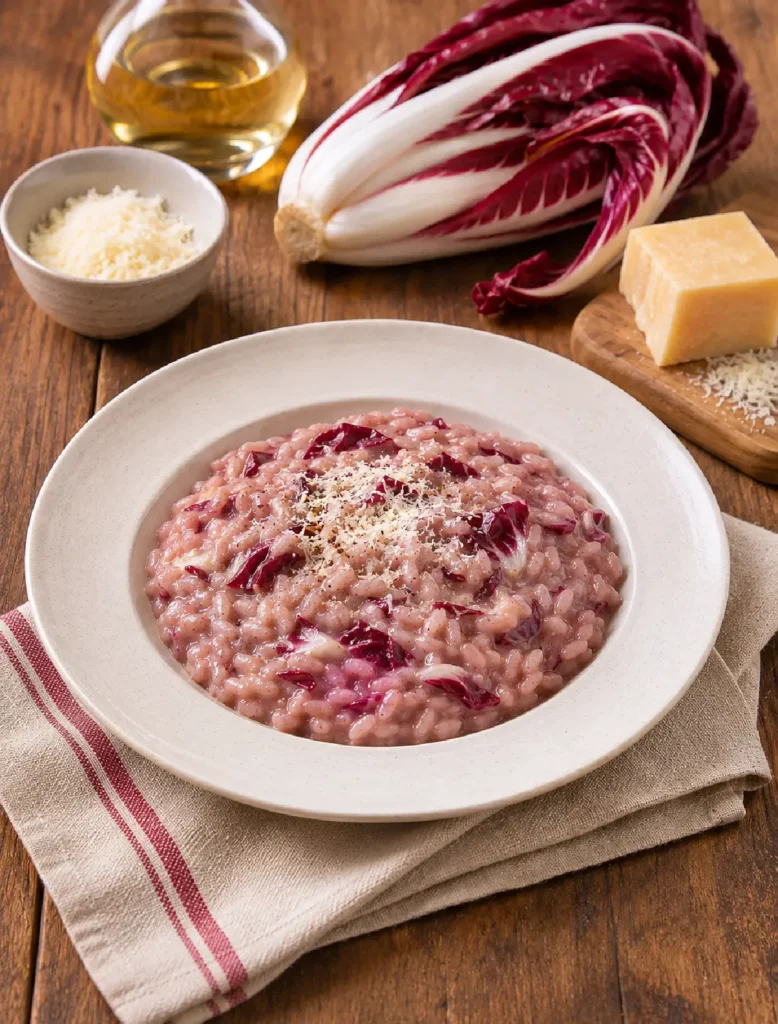
Creamy Venetian risotto with Treviso red radicchio.
As Treviso red radicchio risotto cooks, the rice takes on shades ranging from pink to purple. Tender strips of leaves remain visible between the grains, along with pieces of white rib that retain a slightly firmer texture. The first mouthful is creamy from the butter and Grana Padano, followed by the radicchio’s gentle bitterness, which varies depending on the variety used.
When freshly served, the risotto slowly spreads across the plate. The rice remains al dente, while the radicchio has softened without completely breaking down. The late-harvest tardivo variety tends to have a milder flavour, while the earlier precoce can bring a more pronounced bitterness.
Difficulty:
BeginnerPrep Time15 minsCook Time25 minsTotal Time40 mins
Servings:
4
Calories:
465
Best Season:
Fall, Winter
Description
A traditional Venetian risotto made with Treviso red radicchio, Vialone Nano rice, white wine and Grana Padano, finished with butter until creamy and flowing.
Ingredients
Cooking Mode Disabled
Instructions
How to Make Treviso Radicchio Risotto
Prepare the Radicchio and Onion 🥬
Trim the base of the radicchio and remove any damaged outer leaves. Wash and dry it, then slice it into thin strips, cutting the thicker white ribs into slightly smaller pieces. Peel and finely chop the onion. Meanwhile, heat the vegetable stock in a saucepan and keep it hot throughout the cooking process.
Soften the Onion 🧅
Melt 20 g (0.7 oz) of butter in a deep-sided pan over low heat. Add the chopped onion and cook gently for about 5 minutes, stirring occasionally. It should become soft and translucent without browning.
Cook the Radicchio 🥬
Add the radicchio to the onion and stir to coat it in the butter. Cook over medium-low heat for about 5 minutes, until the leaves soften and reduce in volume.
Add the Rice and White Wine 🍷
Add the rice to the pan and stir to combine it with the radicchio. Let it cook briefly, then pour in the dry white wine. Increase the heat slightly and allow the alcohol to evaporate, stirring continuously.
Cook the Risotto 🍚
Add a ladleful of hot stock and stir. Continue cooking over medium-low heat, adding more stock as the previous addition is absorbed. Keep the rice moist throughout, without allowing it to dry out completely.
Season with salt and cook for about 15 minutes, or according to the cooking time indicated for your rice, stirring frequently. Taste towards the end: the grains should be cooked but still slightly firm in the centre. You may not need all the stock.
Finish and Serve 🧈
Turn off the heat and add the remaining 20 g (0.7 oz) of butter and 40 g (1.4 oz) of grated Grana Padano. Stir vigorously until the risotto becomes creamy and smooth. If it is too thick, add a little hot stock.
Finish with freshly ground white pepper and serve immediately, spooning the risotto onto plates while it is still loose and flowing, known in Italian as all'onda.
Nutrition Facts
Servings 4
Amount Per Serving
Calories465kcal
% Daily Value *
Total Fat15g24%
Saturated Fat9g45%
Sodium650mg28%
Total Carbohydrate69g23%
Dietary Fiber2g8%
Sugars4g
Protein12g24%
* Percent Daily Values are based on a 2,000 calorie diet. Your daily value may be higher or lower depending on your calorie needs.
Note
Which radicchio to use
Treviso red radicchio tardivo, the late-harvest variety, is particularly suitable, but precoce can also be used. If Treviso radicchio is unavailable, Chioggia red radicchio is an alternative, although the shape and texture of the leaves will give a slightly different result.
Choosing the rice
Vialone Nano is particularly well suited to the soft, creamy risottos traditionally prepared in Veneto. Carnaroli is an excellent alternative, especially if you prefer rice grains with a firmer bite. Cooking times vary depending on the rice variety and producer.
Stock and consistency
Use a mild vegetable stock that will not overpower the radicchio. The 1.5 litres (50.7 US fl oz) is the amount to have available, and you may not need all of it. When finishing the risotto, keep it slightly looser than you want it on the plate, as it will thicken quickly.
Storage
Risotto is best eaten immediately. If you have leftovers, cool them quickly and refrigerate in a sealed container for no longer than 24 hours. Reheat thoroughly only once, adding a little water or stock if needed. Do not leave cooked rice at room temperature for extended periods.
Variations
For a stronger flavour, add diced speck or pancetta and cook it with the onion and butter. This is a variation rather than part of the traditional recipe followed here.
Keywords:
radicchio risotto, Treviso radicchio risotto, Italian radicchio risotto, Venetian risotto, red chicory risotto, Vialone Nano risotto
Rate this recipe
The Seed That Fell on the Bell Tower of Dosson
In Dosson di Casier, a few kilometres south of Treviso, local legend has it that everything began with a few birds. Flying over the village, they supposedly dropped the seed of an unfamiliar chicory plant onto the bell tower. Some friars found it, kept it and began cultivating it.
The story belongs to Dosson's rural folklore. The village has long claimed an important role in the origins of Treviso red radicchio, although written evidence only takes us back to the nineteenth century. An agricultural publication from 1862 already mentioned the blanching of radicchio, suggesting that local farmers were familiar with the technique and were experimenting with it.
Cultivation spread rapidly. By 1870, Treviso radicchio was known in other parts of Italy, and by 1884 it was reaching foreign markets. Farms, rural families and merchants had discovered that this winter vegetable could provide a valuable source of income.
The Belgian Gardener Who May Not Have Invented Anything
One of the people associated with the history of radicchio is Francesco Van den Borre, a Belgian gardener who arrived in the Treviso area during the second half of the nineteenth century to work at Villa Palazzi, along the Terraglio road.
Belgian growers were already familiar with techniques for encouraging chicory leaves to develop away from sunlight. The Italian food historian Giuseppe Maffioli suggested that Van den Borre may have helped introduce this knowledge to the Treviso countryside.
There was, however, an unexpected objection. Aldo Van den Borre, the gardener's son, who continued his father's work, denied that his father had played such a role.
Another explanation comes from stories collected among local farmers. Silla Bovo, a retired resident of Treviso, recalled an account he had heard from elderly farmers in Sant'Angelo.
A family had left several field chicories piled in a wheelbarrow. One evening, during a filò, a traditional gathering when neighbours would sit together and talk, someone picked up one of the plants and removed its damaged outer leaves. Inside, they found a red heart that was still perfectly sound.
A Silver Medal Beneath the Loggia dei Trecento
On Thursday, 20 December 1900, the first Red Radicchio Exhibition took place beneath the Loggia dei Trecento in Piazza dei Signori, Treviso.
The event was organised by Giuseppe Benzi, an agronomist originally from Crema who had arrived in Treviso in 1876 to teach at the Riccati Technical Institute.
Benzi directed the Treviso Agricultural Association and devoted much of his career to modernising local agriculture. He founded agricultural newspapers, promoted cooperative initiatives and organised exhibitions showcasing the produce of the surrounding countryside.
The exhibition's first prize went to Antonio De Pieri, nicknamed Fascio, a tenant farmer on the De Reali estate in Dosson. He received a silver medal and 15 lire. Other prizewinners came from Sant'Antonino, Santa Maria del Rovere, Sant'Angelo sul Sile and several other villages in the province.
The exhibition became a regular event in Treviso. In the days leading up to Christmas, growers brought their produce into the city centre, turning the Loggia into a market dedicated to radicchio. The tradition continued through the twentieth century, with interruptions during the two World Wars.
Radicchio in a Painting by Leandro Bassano
In The Wedding at Cana, painted between 1579 and 1582, Leandro da Ponte, better known as Leandro Bassano, depicted a scene filled with people, tableware and food. Among the baskets of vegetables in the composition, some plants with reddish leaves have been identified.
The detail is also mentioned by the Treviso Red Radicchio Protection Consortium as possible evidence that red chicories were already present in Veneto during the sixteenth century.
The Bassano painters paid particular attention to everyday objects. Their works frequently included farmyard animals, fruit, vegetables and utensils inspired by what they saw in local homes and markets.
When Radicchio Began to Travel
By the end of the nineteenth century, Dosson alone was producing more than 400 quintals, approximately 40 metric tonnes, of radicchio each year, with a total value of around 10,000 Italian lire at the time.
Farming families could earn several hundred lire from the crop, with considerably higher returns in particularly favourable years.
Growing trade also changed how radicchio was perceived. Once mainly eaten in the countryside, it began reaching markets in Italian cities and, through merchants, destinations elsewhere in Europe and America.
In 1996, Radicchio Rosso di Treviso received European Protected Geographical Indication (PGI) status. The protection consortium was established in the same year to safeguard and promote the geographical designation.
We use cookies and similar technologies to ensure the website works properly, analyze visits and improve your browsing experience. You can accept, reject non-essential cookies or customize your preferences at any time.
Functional
Always active
Technical storage or access is strictly necessary for the legitimate purpose of enabling the use of a specific service explicitly requested by the subscriber or user, or for the sole purpose of carrying out the transmission of a communication over an electronic communications network.
Preferences
Technical storage or access is necessary for the legitimate purpose of storing preferences that are not requested by the subscriber or user.
Statistics
Technical storage or access that is used exclusively for statistical purposes.L'archiviazione tecnica o l'accesso che viene utilizzato esclusivamente per scopi statistici anonimi. Senza un mandato di comparizione, una conformità volontaria da parte del vostro Fornitore di Servizi Internet, o ulteriori registrazioni da parte di terzi, le informazioni memorizzate o recuperate per questo scopo da sole non possono di solito essere utilizzate per l'identificazione.
Marketing
Technical storage or access is required to create user profiles to send advertising, or to track the user on a website or across several websites for similar marketing purposes.