How to Make Risotto: Toasting, Stock and Mantecatura
Making risotto is not difficult because it involves a lot of steps. The point is that those few steps can make a considerable difference to the result. We can start with excellent Carnaroli and a good stock and still end up with dry, overcooked rice or grains that seem to be floating in the sauce.
Toasting the rice, managing the amount of stock during cooking and getting the mantecatura right matter more than many of the little rules that get repeated whenever risotto is discussed.
And some of those rules, when you look at them closely, are not really rules at all.
Which rice should you use for risotto?
Carnaroli, Arborio and Vialone Nano are probably the names we encounter most often, but they do not behave in the same way.
Carnaroli is a good place to start when we want grains that hold their texture well during cooking. Vialone Nano, with its smaller grains, readily produces a creamy risotto. Arborio has large grains and releases plenty of starch, but it requires a little more attention because it tends to lose its al dente texture more quickly.
That does not mean one is always better than the others. What changes is the margin we have during cooking and, to some extent, the result we can achieve.
When learning the technique, Carnaroli makes things a little easier.
The pan matters too. A wide, heavy-bottomed saucepan works well, giving the rice enough room to spread out without forming an excessively thick layer and helping the heat distribute fairly evenly.
Toasting the rice
We can toast the rice dry or add it after preparing a base with butter, olive oil, onion or other ingredients. Both methods are used in Italian cooking.
Dry toasting has one very practical advantage: it allows us to concentrate entirely on the rice. Put the grains into the hot saucepan and keep them moving so that they heat evenly.
Three or four minutes can be a useful reference, but there is no need to keep staring at the clock.
The rice begins to give off a more noticeable cereal aroma and, if we carefully touch it, the grains should feel distinctly hot. These signs tell us more than a timer does.
It is often said that toasting “seals the grains”, preventing the starch from escaping too quickly. It is a convenient explanation, but it does not describe very well what we actually want from a risotto. We need some of the starch to move into the cooking liquid because that is one of the things that contributes to its creaminess.
So there is no need to imagine that we are making the grains impermeable.
What about the soffritto?
We can prepare the soffritto first and toast the rice in the same saucepan. Plenty of traditional recipes use exactly this method.
Another option is to prepare the base separately and toast the rice dry. This prevents the water released by ingredients such as onion from interfering with this stage and gives us greater control over the temperature of the rice.
There is no need to turn the choice into a battle between old and new methods. It depends on the risotto we are making.
Wine is not compulsory
After toasting, one instruction seems to appear almost automatically: add some white wine and let it evaporate.
We can do that, but only when the wine has a purpose in the recipe.
In that case, add it after toasting and allow the alcoholic component to evaporate before starting with the stock. But wine should not be considered a compulsory step for something to qualify as risotto.
The Risotto alla Milanese we prepare following Milan’s De.Co. recipe, for example, does not include it.
That is worth remembering with other risottos too: start with the dish we want to make rather than a sequence of movements we have learned by heart.
The stock should accompany the rice as it cooks
Vegetable, meat or fish stock, or even a cooking liquid obtained from other ingredients: the choice changes according to the risotto.
One thing remains the same: the stock should be hot.
Keep it in a separate saucepan beside the risotto and add it gradually. This prevents us from repeatedly pouring cold liquid over the rice as it cooks.
Then there is the famous ladle.
Add one ladle of stock and wait until it has been completely absorbed before adding the next.
We do not actually need to go that far every time.
The rice should have liquid available while it cooks. When the amount decreases, add some more. We can be reasonably generous at the beginning. As the rice approaches the end of its cooking time, it makes sense to reduce the amount we add.
If the rice has two minutes left and we pour in a large ladleful of stock, we have created a problem. Either we keep cooking while waiting for it to evaporate, risking overcooking the rice, or we serve a risotto that is too liquid.
How much stock do you need for risotto?
As a general reference, we can allow around 350 ml of stock for every 100 g of rice, but treating this as a fixed ratio would be a mistake. The rice itself, the saucepan and the intensity of the heat all affect absorption and evaporation.
It is therefore better to prepare slightly more stock than we expect to use.
If some is left over, that is not a problem. Running out when the rice still needs another few minutes is much less convenient.
Keeping some stock in reserve will also be useful later, during the mantecatura.
How often should you stir risotto?
There is no need to stir frantically throughout the entire cooking time, but we cannot pour in the stock and forget about the rice either.
Stirring distributes the liquid, helps prevent the rice from sticking to the bottom and encourages the release of starch.
So stir it regularly and gently.
Toasting is slightly different. At that stage, we want to keep the grains moving because they are directly exposed to the hot surface of the saucepan. Once the stock has been added, there is no longer the same need for constant movement.
Rather than counting how many times we have moved the spoon, watch what is actually happening in the pan.
Cooking time is not decided by the timer alone
15-18 minutes is a common guideline for many risotto rice varieties, but the actual cooking time depends on the rice we are using.
The simplest way to find out is something we already know how to do: taste it.
Towards the end of cooking, try a few grains. They should be cooked but still retain some firmness at the centre. It is better to reach the mantecatura a little early than a little late, because the rice does not instantly stop changing the moment we turn off the heat.
Seasoning should also be checked by tasting. Stock may be almost unsalted or already quite savoury, while Parmigiano, other cheeses, cured meats and additional ingredients will change the balance again. Adjust the seasoning as the risotto cooks rather than leaving everything to a final pinch of salt.
Risotto should not be dry before mantecatura
This is probably one of the most useful things to learn.
When the rice reaches the desired point of cooking, there should still be some liquid in the saucepan.
If we turn off the heat when the risotto is already thick and compact, the rice will continue absorbing moisture over the next few minutes and become even drier. Keeping a little hot stock aside allows us to adjust the consistency at this stage.
There is no need to worry if the risotto looks slightly looser than we want it to be on the plate.
This is exactly where the mantecatura comes in.
How to finish risotto with mantecatura
Take the saucepan off the heat and wait a few moments. This brief pause allows the temperature to settle before adding the fats.
A classic mantecatura uses cold butter and grated Parmigiano Reggiano.
Now move the risotto vigorously, either with a spoon or by moving the saucepan itself. We are not simply melting butter into rice. We want the fat, cooking liquid and starch to come together.
If the risotto becomes too thick, add a little hot stock and continue working it until the consistency is right.
Cold butter helps at this stage because it melts gradually as we incorporate it. There is no need, however, to turn refrigerator temperature into an absolute rule or the freezer into a secret ingredient. The result depends on the overall balance between temperature, liquid, starch and fat.
Parmigiano is not compulsory in every risotto either. A seafood risotto, for example, may be finished differently.
Mantecatura is a technique. It does not necessarily mean adding butter and Parmigiano.
What does risotto “all’onda” mean?
The expression describes, first of all, a consistency.
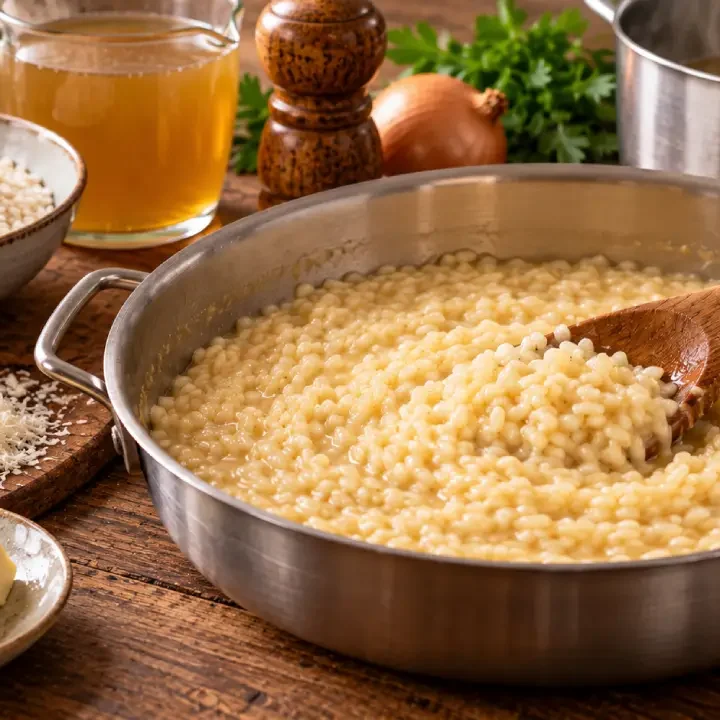
When we move the saucepan, the risotto should flow and fold back on itself like a wave. Once spooned onto the plate, it should naturally spread rather than remaining in the shape left by the spoon.
There should not, however, be a separate pool of stock around the grains.
Risotto all’onda is fluid, not watery.
This is also where the difference between creaminess and overcooked rice becomes clear.
We should still be able to see and feel the individual grains. Around them is the creamy part that brings everything together.
Toasting, stock and mantecatura need to work together
There is no single trick that can save a risotto.
We can toast Carnaroli perfectly and ruin it by adding too much stock during the final minutes. We can cook it to exactly the right point and then allow it to dry out before the mantecatura. We can add the best butter in the refrigerator to rice that is already overcooked, but there is no going back.
Technique is mostly about understanding when something needs to change while we are cooking.
Toast the rice while watching it and checking its heat. Add stock without repeatedly allowing the saucepan to become dry. Use smaller amounts as the rice approaches the end of cooking and start tasting. Turn off the heat while the grains still have some texture and the risotto retains enough liquid for the mantecatura.
Then butter, Parmigiano, when the recipe calls for them, and movement do the rest.
If the risotto slowly spreads across the plate while the grains remain clearly distinguishable, there is no need to count how many ladles of stock we used to know that we have reached the result we wanted.