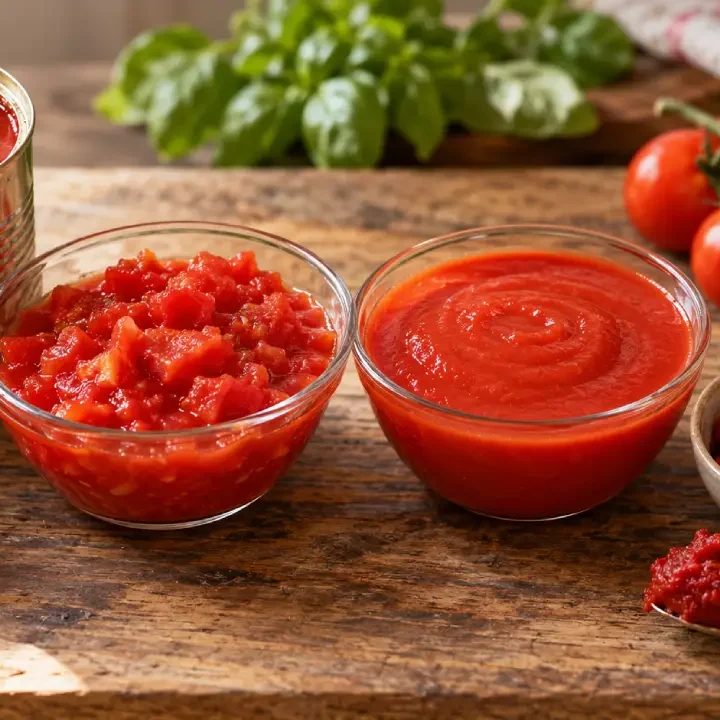
An Italian recipe calls for passata. Another asks for pelati. At the supermarket, you find whole peeled tomatoes, crushed or chopped tomatoes, tomato paste, tomato purée and perhaps a bottle actually labelled passata.
They all start with tomatoes, but they do not behave in the same way once we start cooking.
There is another complication: tomato terminology changes across the English-speaking world. A name used on a British supermarket shelf may mean something different in North America, while Italian terms such as passata are increasingly used without translation.
So when we translate an Italian recipe, finding the right tomatoes matters more than finding the most literal English word.
Whole Peeled Tomatoes
When an Italian recipe calls for pomodori pelati or simply pelati, whole peeled tomatoes are what we mean.
Open the can and the tomatoes are still whole, peeled and packed in tomato juice or another tomato liquid.
We can crush them by hand, break them up with a fork or let them slowly fall apart as they cook. That gives us plenty of control over the final texture of the sauce.
For an Amatriciana, for example, we can crush the tomatoes and still leave the sauce slightly irregular rather than starting with something completely smooth.
The amount of liquid in the can can vary considerably. If there is a lot of it, the sauce may simply need a little longer to reduce.
Crushed, Chopped and Diced Tomatoes
Italian polpa di pomodoro is slightly more difficult to translate.
Polpa is tomato that has already been cut or crushed while retaining visible pieces of the fruit. Those pieces can be very fine in one tin and much larger in another.
Depending on where you shop, you might find crushed tomatoes, chopped tomatoes or diced tomatoes.
They are not necessarily identical. Crushed tomatoes tend to have a finer, less regular texture, while chopped or diced tomatoes usually contain more clearly defined pieces. The consistency can also vary considerably between brands.
If an Italian recipe asks for polpa, look at the texture rather than worrying too much about finding one particular English term on the label.
Passata
Passata is one Italian name worth keeping.
It is made from tomatoes processed into a smooth, strained consistency, with the skins and seeds removed. Unlike whole or crushed tomatoes, there are no distinct pieces left.
That makes passata particularly useful when we want a smooth sauce from the beginning. In a Parmigiana di Melanzane, for example, it gives us an even tomato sauce that is easy to spread between the layers.
Across many English-speaking countries, we can already find bottles and cartons labelled passata. Strained tomatoes is another name we may encounter, particularly in North America.
Be careful with tomato sauce, though. The term can mean different things depending on where we are shopping and may refer to something that has already been cooked or seasoned. If one of our recipes calls for passata, a plain bottle or carton labelled passata is the easiest choice.
Passata and Tomato Purée Are Not Always the Same Thing
Tomato purée is where things get confusing.
In the UK, the name usually refers to the thick tomato concentrate sold in tubes, jars or small tins.
In the US, tomato puree generally means something different: a smooth tomato preparation that is less concentrated than tomato paste.
This is why we do not use tomato purée as a universal translation for Italian passata.
The quantity in a recipe can often help. If it asks for a spoonful, it is probably referring to something concentrated. If it calls for several hundred grams to make the base of a sauce, we are dealing with something quite different.
Tomato Paste and Concentrato di Pomodoro
Italian concentrato di pomodoro is thick, intense and used in much smaller quantities than passata or canned tomatoes.
Much of the water has been removed, which is why a spoonful can add plenty of tomato flavour without making a sauce much wetter.
Think of a ragù that already has meat, vegetables and other liquids in the pot. A little concentrato can strengthen the tomato flavour without turning the whole thing into a tomato sauce.
In much of the English-speaking world, tomato paste is the clearest name for it. In the UK, however, the equivalent is commonly sold as tomato purée.
Italian labels may also say doppio concentrato or triplo concentrato. These indicate increasing levels of concentration.
This one needs a little common sense when making substitutions. 100 g of tomato paste cannot replace 100 g of passata: there is far less water and a much greater concentration of tomato.
Can I Use Passata Instead of Whole Peeled Tomatoes?
Often, yes.
Use passata instead of whole peeled tomatoes and the sauce will be smooth from the beginning. Go the other way and we will need to crush the tomatoes and give them enough time to break down.
Whole peeled tomatoes and polpa are usually even easier to swap, although the size and shape of the pieces will change.
Keep an eye on the liquid as well. If the tomatoes are wetter than the ones the recipe was written for, the sauce may take longer to reduce. If they are much thicker, a little extra liquid may be needed.
Concentrato is different. Rather than trying to replace passata or canned tomatoes gram for gram, use it in the smaller quantities intended for a concentrated ingredient.
What to Look for on the Label
Once we know which tomatoes we need, it is worth checking the ingredient list.
For passata, we prefer something simple, ideally made with just tomatoes. That leaves us free to add salt, garlic, herbs or anything else the recipe needs ourselves.
With canned tomatoes, texture and packing liquid matter more than they might seem. Two cans of the same weight can behave quite differently in a sauce.
And there is one label worth checking twice: tomato purée. If a recipe uses the term, check where it was written and how much it asks for. A spoonful of British tomato purée and a large quantity of American tomato puree are not the same ingredient.