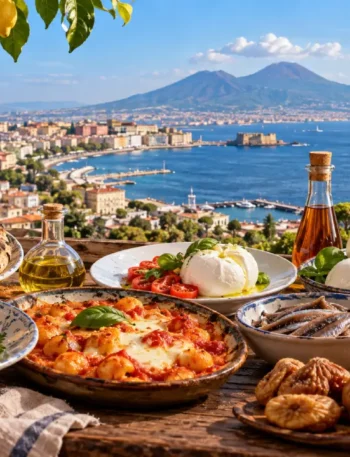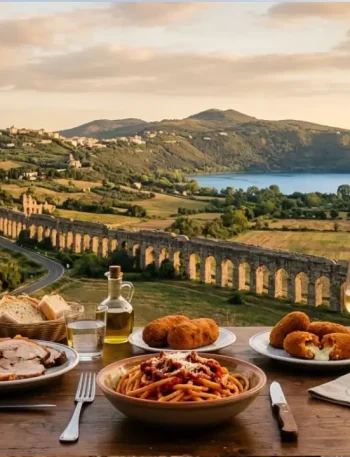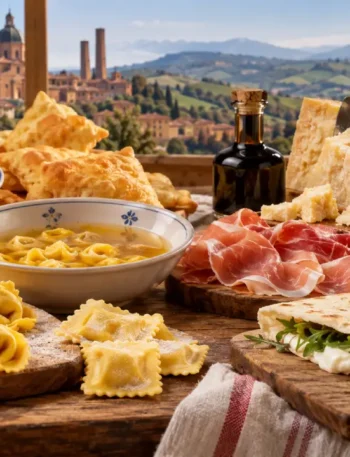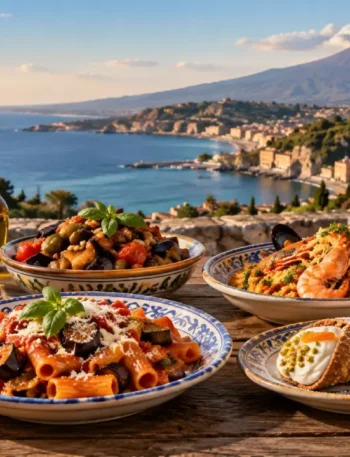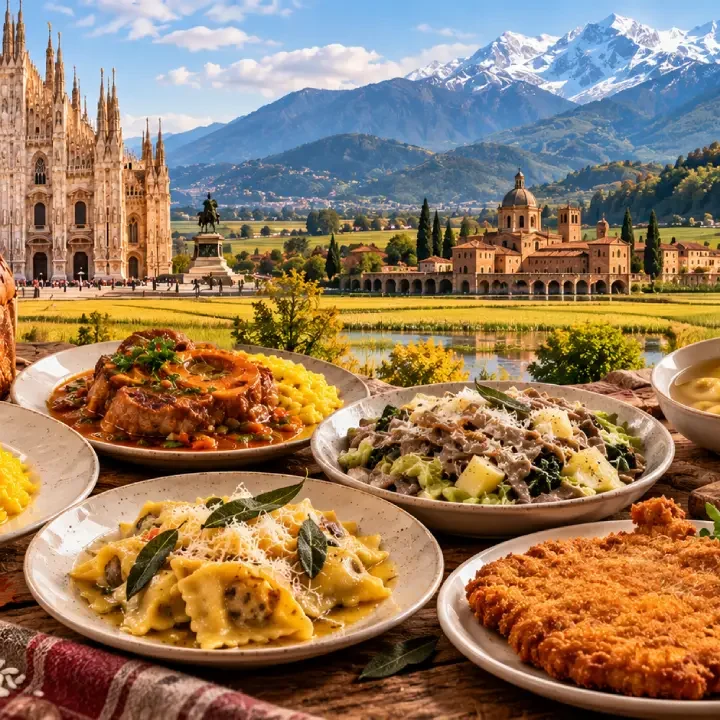
A handful of names is enough to understand how much Milan has shaped the image of Lombard cuisine: Risotto alla Milanese, cotoletta, ossobuco, Mondeghili and Panettone. Dishes that have traveled far beyond the region and are now known well outside Italy.
But leave Milan and cross the plains towards Pavia, head north into Valtellina or travel through Bergamo, Brescia, Mantua and Cremona, and both the ingredients and cooking traditions begin to change considerably.
In Lomellina there are rice fields. In Valtellina, buckwheat and mountain cheeses enter the kitchen. Around Bergamo and Brescia, different versions of casoncelli appear, while in the Mantua area pumpkin and mostarda end up together inside fresh pasta. Then there are the lakes, with a freshwater fish tradition that rarely appears in the best-known image of the region.
Milan, in other words, is a good place to start. But to really understand Lombardy’s food, we need to leave the city.
Milan: saffron, butter and the city’s classics
Risotto alla Milanese is immediately recognizable by the color of saffron, but the traditional preparation includes another ingredient that matters just as much: beef marrow.
It goes into the base with onion and butter before the rice is toasted and slowly cooked. More butter and cheese arrive at the end for the mantecatura, the final stage that gives the risotto its creamy consistency.
Butter appears again and again in Milanese cooking. It is there in the risotto, of course, but also in cotoletta alla milanese. Ossobuco takes things in a completely different direction, with a slow-cooked cut of meat that has become another of the city’s best-known dishes.
Then there are Mondeghili. Traditionally made as a way of using already cooked meat, they belong to a much more domestic side of Milanese cooking. Leftover meat, bread, eggs and other ingredients become meatballs, traditionally cooked in butter.
For our Risotto alla Milanese, we followed the official De.Co. recipe of the Municipality of Milan, starting with marrow, butter and saffron.
In Lomellina, rice begins in the fields
Travel away from Milan towards the province of Pavia and the landscape changes before the food does.
Lomellina is one of Italy’s major rice-growing areas. Here rice is not simply something that goes into a pan to make risotto: its cultivation has been part of local agriculture and the economy for centuries.
Rice fields have reshaped the landscape of the plain, and a local cuisine inevitably developed around the crop. It is hardly surprising to find rice appearing in so many preparations from this part of Lombardy.
Around Mortara, another less predictable ingredient enters the picture: goose. Salame d’Oca di Mortara IGP, a protected goose salami, is one of the area’s most distinctive specialties.
Rice and livestock farming already tell a story quite different from the Milan we left only a short distance away.
In Valtellina, buckwheat and mountain cheeses take over
Then the plain comes to an end.
As we climb towards Valtellina, buckwheat, butter and mountain cheeses begin appearing in the local recipes. Pizzoccheri della Valtellina are probably the dish that makes the change most obvious.
Buckwheat flour goes into the pasta dough, which is then cooked with potatoes and vegetables and generously dressed with cheese and butter.
Buckwheat also appears in sciatt, small fried fritters with a melted cheese center, and alongside cornmeal in polenta taragna.
These valleys are also home to Bitto and Valtellina Casera, while Bresaola della Valtellina comes from the local tradition of curing beef.
By now, the food looks very different from what we encountered in Milan and among the rice fields around Pavia.
In Bergamo, casoncelli meet butter and sage
In Bergamo, one of the best-known examples of stuffed pasta is casoncelli alla bergamasca, or casonsei.
A rich filling sits inside the pasta, while butter, sage, grated cheese and pancetta go on top. It is difficult to imagine casoncelli without their dressing, because the flavored butter is very much part of the character of the dish.
Polenta has an equally important place in the local cuisine, particularly in the valleys. Corn, cheese and products from livestock farming provided the basis of everyday meals for generations.
Casoncelli, however, do not stop at the provincial border. Travel towards Brescia and they appear again, often with different shapes and fillings.
There is more than one cuisine in the Brescia area
It is difficult to choose a single dish to represent the area around Brescia. The territory runs from the plains into the valleys and reaches both Lake Garda and Lake Iseo, with the food changing along the way.
There are Brescian casoncelli, with numerous local variations, and spiedo bresciano, a traditional spit-roasted meat preparation particularly associated with the hills and Pre-Alpine areas and with a slow cooking process that takes time.
Then we reach the water.
And a side of Lombard cuisine that is rarely discussed outside the region suddenly becomes much easier to see.
On the lakes, fish changes the menu
Think of Lombardy and rice, polenta, meat and cheese probably come to mind before fish.
Yet Garda, Iseo, Como and Maggiore have all developed their own traditions around fishing.
Tench, whitefish, shad and other freshwater species appear in recipes according to what each lake provided. On the shores of Lake Como, for example, shad are traditionally dried and preserved to make missoltini.
Around Lake Iseo, tench appears in several local preparations.
For communities living beside the water, fish was never an unusual part of Lombard cooking. It was simply one of the resources available nearby. From the plains this can look almost like a different cuisine. From the shore of a lake, it makes perfect sense.
In Mantua, pumpkin and mostarda share the same pasta
In Mantua, opening a tortello is enough to change direction once again.
Tortelli di Zucca combine pumpkin, cheese, amaretti and mostarda in their filling. Sweet, savory and aromatic flavors sit together inside the same pasta, in a combination closely connected with Mantuan cooking and its Renaissance history.
But Mantua is also rice country.
Risotto alla Pilota takes its name from the workers of the pile, the facilities where rice was processed. Its cooking technique is unusual: the rice cooks by absorption before being dressed with local sausage and cheese.
Tortelli and Risotto alla Pilota could almost have come from two different kitchens. One carries the legacy of court cooking; the other is closely connected with agricultural work and rice production. Both found a place on the same Mantuan table.
In Cremona, stuffed pasta becomes Marubini
A little farther west, we find another stuffed pasta.
Marubini belong to the culinary tradition of Cremona and are served in broth. Here the broth is not merely an accompaniment. It can be prepared by combining different meats and becomes an essential part of the dish itself.
Boiled meats also bring mostarda cremonese to the table, made with fruit and characterized by the sharp heat of mustard.
We encountered mostarda only a short distance away inside Mantua’s Tortelli di Zucca. In Cremona the context changes, and so does the way it is served.
Then come the desserts
At this point, we can return to Milan.
Panettone began as a Milanese specialty but has long since traveled beyond both the city and Lombardy. Flour, butter, eggs, sugar, raisins and candied fruit produce a tall leavened cake that requires far more time and technique than its almost universal appearance at Christmas might suggest.
In Mantua, Sbrisolona goes in a completely different direction. It is crumbly and irregular, traditionally broken into pieces rather than neatly sliced. Its origins are associated with simpler country preparations that were later enriched.
Then there is Cremona, with torrone.
Three cities we have already visited for risotto, stuffed pasta and mostarda return at the end with three desserts that have very little in common.
From the plains to the mountains, with the lakes in between
Put these dishes on a map and Milan quickly stops taking up the whole region.
Risotto alla Milanese stays in the regional capital, followed by the rice fields of Lomellina. Farther north come the pizzoccheri of Valtellina. Around Bergamo and Brescia, casoncelli, polenta and meat dishes change from one area to another, while freshwater fish appears along the lakes. Back on the plains, we find Mantua’s Tortelli di Zucca and Cremona’s Marubini.
And there is still plenty missing.
We have not talked about cassoeula, we have only touched on polenta and cheese, and many dishes from the valleys, soups, cured meats and recipes known mainly in the places where they originated have been left out.
Perhaps that is inevitable. A region stretching from rice fields to the Alps and containing some of Italy’s largest lakes was never likely to be summed up by a single cuisine.
Milan gave Lombardy some of its most famous dishes. The rest of the region kept cooking in its own way.
Want to bring a taste of Lombardy into your kitchen? 👉 Discover all our Lombardy recipes.