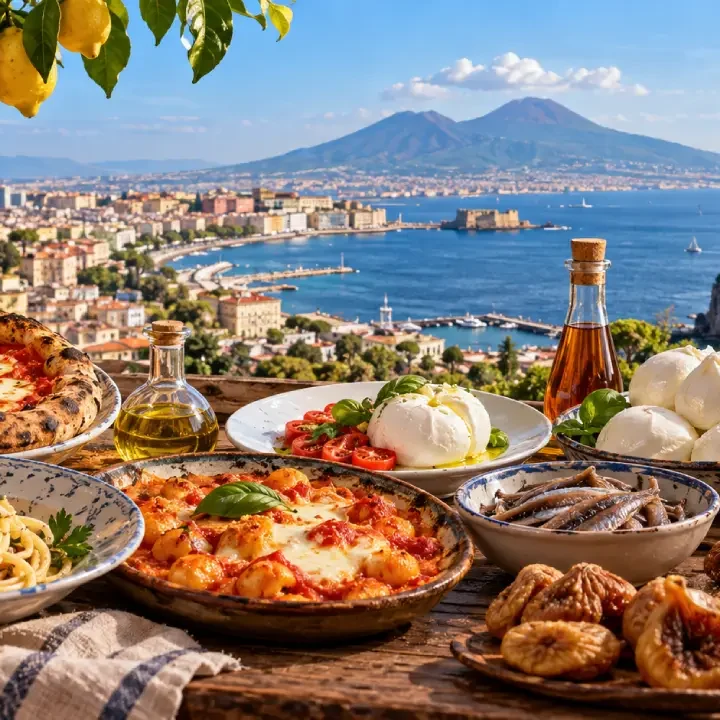
Pizza, mozzarella, Pasta alla Genovese, sfogliatelle. Start talking about Campanian cuisine, and it does not take long before Naples takes over the conversation.
That is hardly surprising. The city has an extraordinary repertoire: Pizza Margherita, Pasta e Patate, Ragù Napoletano, Genovese, Sartù di Riso, Gattò di Patate, Casatiello, friarielli, and enough pastries to fill a shop window on their own.
But move away from the city and quite a few things change. Around Vesuvius, small tomatoes are still preserved in hanging clusters for months. The Sorrento Peninsula has its lemon groves and cheeses; Cetara its anchovies and colatura; farther inland, handmade pasta, cured meats and a cuisine shaped much more by the mountains.
Farther south lies Cilento, where coast and countryside share the same territory without necessarily sharing the same cooking.
Naples remains at the centre of the story, but it cannot tell the whole thing.
Naples, far more than pizza
The name points in the wrong direction, but the aroma certainly does not. In Naples, Genovese is a sauce made with meat and a large quantity of onions, cooked slowly until the onions almost disappear and the sauce becomes thick and rich.
In the traditional preparation, the amount of onion matters. The meat cooks in the sauce and can be served separately, leaving all that slowly cooked onion sauce for the pasta.
It is one of those Neapolitan recipes where time does much of the work.
Pasta e Patate takes a completely different route. Pasta and potatoes cook in the same pot and should end up almost clinging to one another. In Naples, they call it azzeccata: there should be no broth sitting at the bottom, just a creamy consistency created during cooking rather than by adding cream or taking other shortcuts at the end.
Then, of course, there is pizza.
Neapolitan Pizza Margherita has become one of the most recognisable Italian dishes in the world, but pizza in Naples also means marinara, fried pizza and a relationship with dough and ovens that goes far beyond the Margherita.
Step into a friggitoria and you will find crocchè, fried pasta frittatine and other snacks best eaten while they are still hot, often without ever needing to sit down at a table.
Pomodorino del Piennolo del Vesuvio
A cluster of small tomatoes hanging from the ceiling is not an unusual sight around Vesuvius.
The Pomodorino del Piennolo del Vesuvio PDO takes its name from this traditional method of storage. The tomato clusters are tied together to form large piennoli, then hung in well-ventilated rooms.
Their firm skin and strong attachment to the stalk help them keep for a long time. Part of the summer harvest can therefore be used through autumn and winter, when fresh tomatoes are no longer growing in the garden.
Before refrigerators and commercially preserved foods became commonplace at home, keeping a summer crop for this long had a very practical purpose.
Tomatoes, however, are only part of what grows around Vesuvius. Differences in altitude, exposure and volcanic soils have allowed very different crops to develop within a relatively small area.
What do people eat on the Sorrento Peninsula?
Lemon groves are one of the most recognisable sights on the Sorrento Peninsula. Traditionally, the trees are protected by structures that shelter them from cold weather and wind while helping growers manage the ripening of the fruit.
This is where Limone di Sorrento PGI is grown, a lemon with a peel particularly rich in essential oils. Limoncello is the obvious connection, but these lemons also find their way into pastries and many other local preparations.
The peninsula is also home to Provolone del Monaco PDO, an aged stretched-curd cheese made from cow’s milk. In texture and flavour, it is a long way from the fresh cheeses more readily associated with Campania.
Then there are Gnocchi alla Sorrentina.
Tomato sauce, fior di latte, Parmesan and basil are combined with the gnocchi before everything goes into the oven. They should reach the table still creamy, with the cheese melted and stretchy without the oven having dried out the sauce.
Cetara and colatura di alici
In Cetara, anchovies are not only eaten fresh.
They are also packed in salt, releasing liquid as they mature. This liquid is collected and filtered to produce Colatura di Alici di Cetara PDO, an amber-coloured, intensely savoury condiment used in small quantities.
One of the simplest ways to come across it is with pasta. Spaghetti with colatura is also associated with meals traditionally prepared for religious vigils, and the sauce needs very few other ingredients.
Behind that little bottle is a tradition of processing anchovies in Cetara that long predates the product’s current popularity.
Buffalo mozzarella between Caserta and Salerno
Mozzarella di Bufala Campana PDO is easily associated with Naples, but two Campanian areas have historically played a particularly important role in buffalo farming: the Volturno plain, around Caserta, and the Sele plain, in the Salerno area.
Buffalo milk produces a different mozzarella from cow’s-milk Fior di Latte. Cut into one and you immediately see the whey escape. That is part of the pleasure when mozzarella is eaten fresh, but something to keep in mind when it is going onto a pizza or into a baked dish.
With Caprese, that problem disappears. Tomatoes, mozzarella, basil and olive oil never go near the oven, so the mozzarella can be served with the liquid it naturally releases when cut.
The name takes us to Capri, the island generally associated with the origins of the salad, although establishing precisely how and when it first appeared is much harder than recognising it on the plate.
From the coast to Irpinia
Irpinia looks very different from the familiar image of Campania filled with sea views, lemons and tomatoes.
Woodland and mountains cover much of the area, while its cooking brings in homemade pasta, pork, cured meats, cheeses, chestnuts and pulses.
Fusillo avellinese, for example, is a traditional pasta shaped around a thin metal rod. Flour and water are enough for the basic dough; the hands and the rod give each piece its long, twisted shape.
In Bagnoli Irpino, there is nnoglia, a pork sausage seasoned with ingredients including chilli and fennel. It can also find its way into minestra maritata, a dish combining vegetables and meat that belongs to a much broader Campanian tradition.
Bread and torrone in Sannio
Benevento and the surrounding area have a long tradition of making torrone. Almonds, hazelnuts and honey appear in different versions, while San Marco dei Cavoti is particularly well known for its croccantino.
Sannio is not all about sweets, though.
In Cusano Mutri, there is potato bread. Boiled potatoes are mashed and incorporated into the dough with flour and sourdough before the bread is left to rise and baked.
These foods have travelled far less widely than pizza or mozzarella. Sometimes you really do have to reach the towns where they were born to come across them.
Cilento
A small piece of dough, a thin metal rod and the movement of your hands.
Fusillo di Gioi is shaped by rolling the dough around the rod until it becomes long and slender. Felitto has another tradition of handmade fusilli, with characteristics of its own.
Fico Bianco del Cilento PDO goes in a completely different direction. Some of these white figs are dried so they can be kept long after the harvest. They can be eaten as they are or filled and combined with other ingredients.
Along the coast, fish takes over again.
At Marina di Pisciotta, fishermen still practise the traditional method used to catch alici di menaica. The menaica is a net that catches the larger anchovies. They are removed from the mesh one by one and processed soon after the catch, including by preserving them in salt.
Within a relatively short distance, the food changes from pasta shaped around a metal rod to dried figs and then to anchovies brought back by fishing boats.
Campanian cuisine beyond Naples
Naples has exported an extraordinary number of dishes, and it would be difficult to talk about the food of Campania without giving the city plenty of space.
The problem only begins when Neapolitan cuisine and Campanian cuisine are treated as two names for the same thing.
They are not.
Naples may be the easiest place to start. But it is worth continuing the journey, because some of the most interesting food appears when the dishes we already know by heart give way to those that have travelled far less beyond Campania.
Want to bring a little Campania into your kitchen? 👉 Discover all our Campanian recipes on DishToHub.