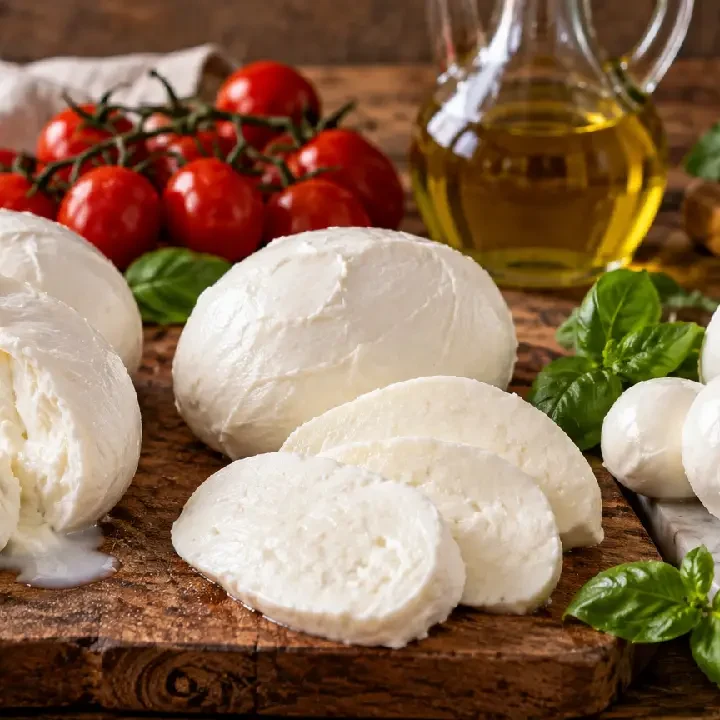
At the cheese counter, it all seems simple enough: mozzarella, Fior di Latte and buffalo mozzarella. Three familiar names, at least until you start looking at what they actually mean.
Most of the confusion begins with the word mozzarella itself. In everyday Italian, we use it all the time, sometimes for the cow’s milk mozzarella found in supermarkets and sometimes with buffalo mozzarella in mind. The name alone, however, does not tell you which milk was used.
Mozzarella takes its name from mozzatura, the action of cutting off portions of stretched curd to form the individual cheeses. And mozzarella can indeed be made from different types of milk. Mozzarella di Gioia del Colle PDO, for example, is made from cow’s milk.
Milk matters, of course, but it is not the only thing worth looking at.
Fior di Latte is made from cow’s milk
With Fior di Latte, we can be much more specific: it is a fresh stretched-curd cheese made from cow’s milk.
It has particularly deep roots in Campania, where it is included among the region’s PAT (Prodotti Agroalimentari Tradizionali), or Traditional Agri-Food Products. Fior di Latte from Agerola, in the Monti Lattari, is probably one of the best-known examples.
The production process also explains why Fior di Latte and cow’s milk mozzarella are so easily confused. Both involve stretched curd that is then cut and shaped into different forms.
That does not mean the two names can automatically be swapped whenever we come across a fresh stretched-curd cheese made from cow’s milk. Fior di Latte has its own tradition, and its characteristics also depend on the milk, production method and cheesemaker.
What about Mozzarella di Bufala Campana?
The first difference here is the milk. Mozzarella di Bufala Campana PDO is made exclusively from fresh buffalo milk and must follow a specific production specification, covering everything from the origin of the milk to the way the cheese is made.
There is also a small geographical surprise. Despite the name, the PDO area does not end at the borders of Campania. It also includes designated areas of Lazio, Puglia and Molise.
The more interesting differences become apparent when you cut into the mozzarella.
Mozzarella di Bufala Campana PDO has its characteristic porcelain-white color and, when freshly cut, releases the slightly milky whey that many of us will have seen before. Its texture changes as you chew it, while buffalo milk gives the finished cheese characteristics that differ from those of an equivalent cow’s milk product.
And that whey is not just something you notice on the plate. It becomes important once you start cooking.
On pizza, you can see the difference immediately
Anyone who regularly makes pizza at home knows what can happen: mozzarella that is too wet can leave a small pool of water exactly where you do not want it.
Fior di Latte, particularly when it has been well drained, is generally straightforward to work with. Cut it, give it time to lose some of its liquid, and it will melt in the oven without bringing an excessive amount of water with it.
Buffalo mozzarella needs a little more attention. It contains more whey and, if it goes straight from its liquid onto the pizza, it can release quite a lot of moisture during baking. This is even more noticeable in a home oven, where pizza takes longer to cook than it does in the intense heat of a pizzeria oven.
That does not mean buffalo mozzarella should not be used on pizza. In our Neapolitan Pizza Margherita, for example, Mozzarella di Bufala Campana PDO is one of the options. The important thing is to cut it ahead of time and let it drain thoroughly.
Caprese is a different story
Tomatoes, mozzarella, basil and olive oil. In a Caprese Salad, there is no oven to worry about, so the whey no longer needs to be kept under control.
A Mozzarella di Bufala Campana PDO can be enjoyed exactly as it is, with its particular texture and the liquid it releases when cut. Use a good Fior di Latte instead and the dish changes: its flavor stays closer to cow’s milk, and the texture is different too.
Both work in a Caprese, so here the choice can simply come down to which one you prefer.
Parmigiana and baked dishes: watch the moisture
Something different happens in Eggplant Parmigiana. The mozzarella is enclosed between layers of eggplant, tomato sauce and Parmigiano, so the liquid released during baking can easily remain trapped in the dish.
The mozzarella should therefore be drained thoroughly before you use it, just as we do in our Parmigiana recipe.
A reasonably dry Fior di Latte makes things easier. A mozzarella with more whey can work just as well, but it needs more time to drain.
This is one of those cases where changing the mozzarella does more than alter the flavor: it can also change the consistency of the Parmigiana when you cut into it.
PDO and TSG do not mean the same thing
You may come across another name on the packaging: Mozzarella Tradizionale TSG.
It is worth explaining the abbreviation because it is easily confused with PDO. A PDO (Protected Designation of Origin) also connects a product to a particular geographical area and establishes specific rules for its production. A TSG (Traditional Speciality Guaranteed) protects a traditional product or production method without tying it to a particular geographical area in the same way.
In the case of Mozzarella Tradizionale, specific production techniques are protected, including the use of a natural whey starter culture.
It is therefore not a more or less prestigious version of Mozzarella di Bufala Campana PDO. The two designations are simply protecting different things.
In the end, the word mozzarella on its own may tell us less than we think. If we want to know what we are buying, the full name and the type of milk on the label tell us much more. Then we can think about the recipe: on pizza, what matters is how much liquid the cheese will release; in Parmigiana, how well we can drain it; and in a Caprese, we can mostly choose the one we enjoy eating most.