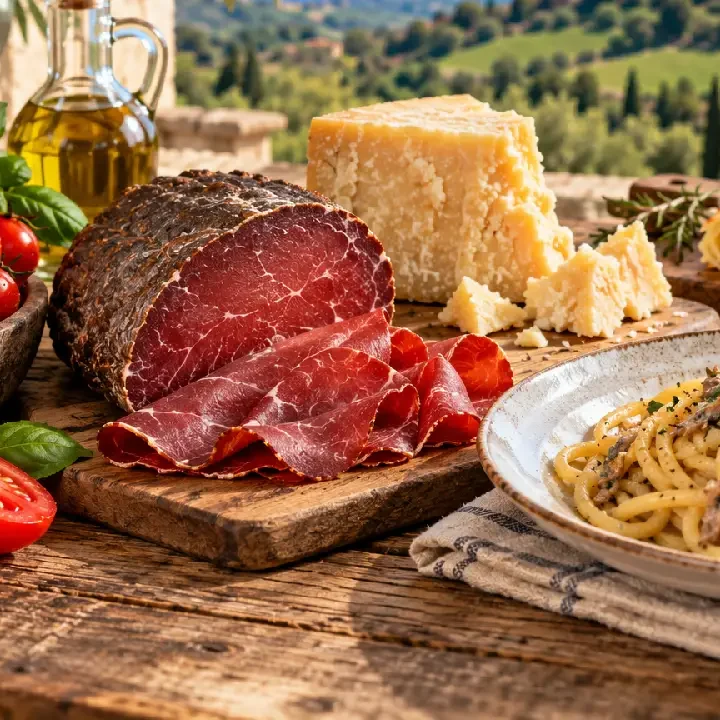
You might buy a PDO cheese, come across a PGI cured meat or read that an Italian regional speciality is recognised as PAT without knowing exactly what these abbreviations mean. They appear on food packaging, restaurant menus and in articles about Italian cuisine, often alongside words such as origin, quality and tradition.
Yet PAT, PDO and PGI are not interchangeable. The European designations PDO and PGI establish specific rules for the use of protected geographical names. PAT recognition, on the other hand, documents food products and preparations rooted in local traditions.
To understand the differences, consider three examples: tomatoes grown and processed in Campania, cured beef produced in Valtellina and a regional speciality prepared according to methods handed down through generations.
PDO: When Every Stage of Production Is Linked to the Region
PDO (Protected Designation of Origin) is a European designation reserved for products whose qualities or characteristics are essentially or exclusively determined by their geographical environment, including natural and human factors.
To use this designation, every stage of production must take place within the defined geographical area and comply with an official product specification.
Pomodoro San Marzano dell’Agro Sarnese-Nocerino PDO provides an interesting example. The designation covers peeled tomatoes obtained from specified tomato varieties, grown and processed within designated areas of the provinces of Salerno, Naples and Avellino.
The product’s characteristics depend on the local growing conditions, the selection of tomato varieties and the production methods used. Growing San Marzano tomatoes in another Italian region is therefore not enough to sell them under the same protected designation.
The same principle applies to Parmigiano Reggiano PDO. Milk production, cheesemaking and ageing must all take place within the geographical area established by its product specification.
PDO recognition therefore guarantees a defined geographical origin and compliance with production rules subject to official controls.
PGI: When the Geographical Link Can Involve Just One Production Stage
PGI (Protected Geographical Indication) is also a European designation, but its relationship with geographical origin works differently.
To qualify, a product must possess a quality, reputation or other characteristic attributable to its geographical origin. At least one stage of production must take place within the designated area, in accordance with the product specification.
Bresaola della Valtellina PGI illustrates this distinction particularly well.
This air-dried cured beef is produced in the province of Sondrio, in Lombardy, through processes that include salting, drying and ageing. The valley’s climatic conditions and the expertise developed by local producers have helped shape the characteristics of bresaola.
However, the beef used does not necessarily have to come from Valtellina. The product specification establishes requirements for the raw material and the processing stages that must take place within the recognised geographical area.
The origin of the beef and the location where bresaola is produced are therefore two separate considerations.
This does not mean that PGI products are subject to less rigorous controls than PDO products. Both designations require compliance with official specifications and verification procedures.
PAT: When Recognition Is Based on Food Traditions
PAT (Prodotti Agroalimentari Tradizionali, or Traditional Agri-food Products) follows a different approach. These specialities are identified by Italy’s Regions and Autonomous Provinces and included in a national list maintained by the Italian Ministry of Agriculture, Food Sovereignty and Forests.
The main requirement concerns traditional processing, preservation or ageing methods, which must have been practised consistently according to established rules for at least 25 years.
Unlike PDO and PGI, PAT is not a protected European geographical designation. Its purpose is to identify and document products and preparations that form part of Italy’s regional food traditions.
The national list covers a wide variety of foods, from cheeses and cured meats to preserves, baked goods, fresh pasta, desserts and prepared dishes.
Examples include bigoli in salsa from Veneto, a pasta dish traditionally dressed with onions and preserved fish, and crescia sfogliata di Urbino, a speciality from the Marche region made with dough that is rolled and folded to create delicate layers.
Both were added to Italy’s national PAT list in 2025, although their culinary traditions date back much further.
These preparations show just how varied the PAT list can be. It includes not only individual food products but also complete dishes and traditional cooking methods that remain part of regional cuisine.
PAT, PDO and PGI Compared
The main differences between the three forms of recognition can be summarised as follows.
PDO
Recognition: European
Geographical link: Every production stage within the defined area
Requirements: Official product specification
Name protection: Yes
Example: Pomodoro San Marzano dell’Agro Sarnese-Nocerino
PGI
Recognition: European
Geographical link: At least one production stage within the defined area
Requirements: Official product specification
Name protection: Yes
Example: Bresaola della Valtellina
PAT
Recognition: Italian
Geographical link: Documented local food tradition
Requirements: Traditional methods established for at least 25 years
Name protection: Not equivalent to PDO or PGI
Example: Farinata Genovese
A PDO product is not automatically better than a PGI product, just as a PAT speciality is not necessarily of lower quality. These abbreviations indicate different requirements and forms of recognition, not a ranking of taste or quality.
How Can You Recognise PDO, PGI and PAT Products When Shopping?
PDO and PGI food products can be identified by their respective European symbols, which indicate that the product is registered under a protected geographical designation. For prepacked agricultural and food products covered by these schemes, displaying the appropriate European symbol is mandatory under EU rules.
These labels help consumers distinguish officially recognised products from foods that simply refer to a geographical location in their marketing or description.
A cheese described as similar to Parmigiano Reggiano is not the same as Parmigiano Reggiano PDO. Likewise, tomatoes belonging to the San Marzano variety are not necessarily Pomodoro San Marzano dell’Agro Sarnese-Nocerino PDO.
PAT works differently. There is no equivalent European PAT symbol comparable to the PDO and PGI logos. The most reliable reference is Italy’s official national list, which organises traditional products by region and category.
It is also worth remembering that using a PAT ingredient does not automatically make the finished recipe a PAT speciality. For a dish to be described as PAT, the specific preparation must appear on the official list.
Three Designations, Three Ways to Understand Italian Food
PDO identifies products whose characteristics are closely linked to a particular geographical area and its production stages. PGI can also recognise local processing traditions that use raw materials sourced from elsewhere. PAT documents foods and techniques that belong to Italy’s regional culinary heritage.
Understanding these differences makes it easier to interpret food labels and appreciate what lies behind the products we buy.
For anyone who enjoys cooking, the PAT list also offers an opportunity to discover lesser-known Italian specialities. On DishToHub, you can explore a selection of recognised PAT recipes, learn about their characteristics and try preparing them at home.