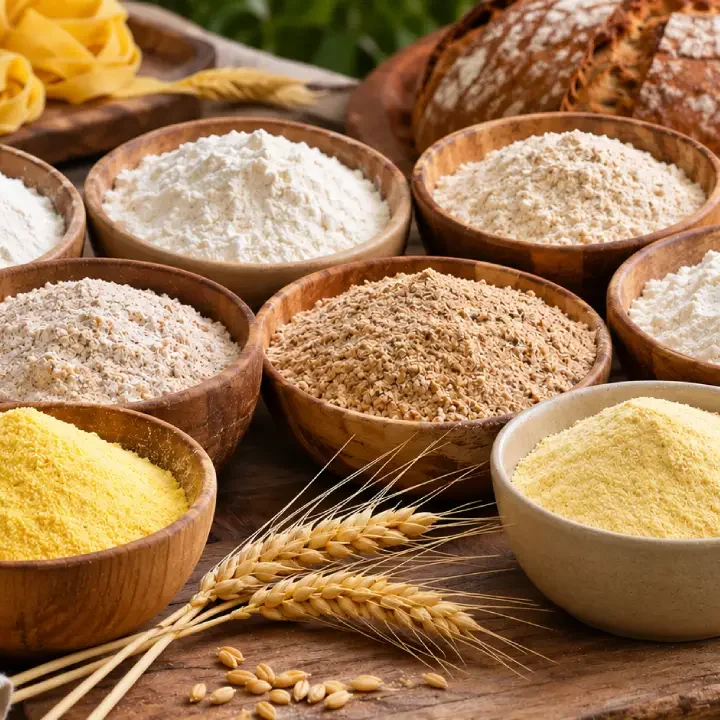
A bag of Italian 00 flour for biscuits and one intended for pizza may look almost identical. They carry the same number and have the same colour, yet using them in the same recipe can produce very different results. The same happens when replacing white flour with whole wheat flour without adjusting the amount of water, or when buying semolina to make orecchiette and ending up with a dough that feels too grainy.
Alongside type 00 and type 0 flour, there are types 1 and 2, whole wheat flour, Manitoba flour, semolina and remilled semolina. Some of these names refer to the degree of refinement, while others describe the type of wheat or the properties of the flour.
Outside Italy, choosing the right flour becomes a little more complicated. American supermarkets sell all-purpose flour and bread flour, British shops stock plain flour and strong white flour, while flour packaging in France and Germany displays numbers that differ from those used in Italy.
Soft Wheat and Durum Wheat: Understanding the Difference
The distinction between soft wheat and durum wheat can be seen throughout Italian regional cooking. Take the fresh egg pasta of Emilia and the orecchiette of Puglia: the former is made with soft wheat flour and eggs, while the latter is prepared with durum wheat semolina and water.
Soft wheat is used to produce Italian type 00, type 0, type 1, type 2 and whole wheat flours, which are suitable for everything from shortcrust pastry to bread. Durum wheat has harder, more compact kernels. When milled, it produces semolina, recognisable by its grainy texture and golden-yellow colour.
Looking at a wheat kernel cut in half reveals three main parts: the endosperm, the inner portion made up primarily of starch and proteins; the bran, which consists of the outer layers rich in fibre and minerals; and the germ, from which a new plant can grow.
During milling, these components are separated and selected. White flour comes mainly from the inner part of the kernel, while less refined flours retain more of its outer layers. Whole wheat flour also contains the bran and germ.
Italian 00 Flour vs 0 Flour: What Is the Difference?
It is difficult to tell them apart by sight alone. Both are white, fine and almost powdery, although type 0 flour sometimes has a slightly ivory colour.
Type 00 is the most refined Italian soft wheat flour. It has a mild flavour and is used to make fresh pasta, pastries, bread and pizza. Type 0 flour is slightly less refined and is often associated with bread making, although some 00 flours are considerably stronger than many type 0 flours.
Either type can be used for Piedmontese agnolotti, Tuscan pici or potato gnocchi. When making bread or pizza, however, the amount of water and the fermentation time specified in the recipe also influence the choice of flour.
It is therefore worth reading the other information on the packaging. A type 00 flour intended for fresh pasta, for instance, has been selected to produce a dough that is easy to roll out, whereas one designed for long-fermentation pizza needs to meet quite different requirements.
Italian Type 1, Type 2 and Whole Wheat Flour
The differences between less refined flours become apparent as soon as the bag is opened. Their colour changes, the aroma of the wheat becomes more noticeable and, when making dough, the amount of water often needs adjusting.
Type 1 Flour
Italian type 1 flour retains more of the outer parts of the wheat kernel than types 00 and 0. It has an ivory colour and may contain small, darker flecks.
Its flavour comes through particularly well in simple preparations. In a focaccia topped with nothing more than extra virgin olive oil and salt, for example, the flavour of the wheat is more pronounced than in a dough made with white flour.
Type 1 flour works well in bread, pizza and focaccia, either on its own or blended with type 0 or 00 flour. It is a good choice for anyone looking for a more rustic flavour without switching entirely to whole wheat flour.
Type 2 Flour
Often described in Italy as semintegrale, or semi-wholemeal flour, type 2 contains more bran than type 1. In bread, the difference is particularly noticeable in the crumb, which tends to be darker and has a more pronounced wheat aroma.
Replacing type 0 flour with type 2 may require a little extra water, as the bran tends to absorb more moisture. The dough may also be less extensible, resulting in bread with a denser crumb.
Type 2 flour is not limited to bread making. Its distinctive flavour works particularly well in biscuits and tarts containing honey, hazelnuts, almonds or fruit preserves.
Whole Wheat Flour
The aroma of freshly baked whole wheat bread often brings to mind toasted grains and, sometimes, nuts. Its crumb is darker, and the flavour remains noticeable even when the bread is served alongside other foods.
Compared with refined flour, whole wheat flour contains more fibre and retains higher amounts of several minerals. The presence of bran requires a little extra attention when preparing dough, particularly when it comes to water.
A whole wheat dough that initially seems too soft may become firmer after resting. The fibre needs time to absorb the water, so adding more flour too early can result in unnecessarily dry bread.
Bran particles can also interfere with the formation of the elastic structure that traps gases during fermentation. This is one reason why whole wheat bread may have a denser crumb than white bread.
For a more pronounced wheat flavour while retaining some of the softness associated with white flour doughs, whole wheat flour can be blended with type 0 flour. The same approach works well for pizza, focaccia, biscuits and tarts.
Manitoba Flour: What Makes It Different?
Manitoba flour appears frequently in recipes for panettone, pandoro, colomba and brioche. Butter, eggs and sugar make these doughs particularly demanding to work with. They require flour capable of supporting fermentation and maintaining the structure of the dough throughout extended mixing and rising times.
The name comes from the Canadian province of Manitoba, historically associated with the production of particularly strong wheat. Today, flour sold as Manitoba in Italy may also be made from wheat grown in other parts of the world.
The name does not indicate the degree of refinement. A single bag may be labelled both Manitoba and type 0 flour, or Manitoba and type 00 flour.
Its defining characteristic is its high strength. It can be used on its own or blended with weaker flours to produce doughs capable of retaining the gases released during fermentation.
Not every yeast-leavened dough requires Manitoba flour, however. Ordinary bread flour is often sufficient for a simple loaf or a focaccia prepared on the same day. In shortcrust pastry, very strong flour can actually work against the desired result, making the dough more elastic and the baked pastry less crumbly.
Durum Wheat Semolina and Remilled Semolina
Rub a little of each between your fingers and the difference becomes immediately apparent. Ordinary semolina has an almost sandy texture, while remilled semolina is finer and feels more like white flour. Both retain the distinctive yellow colour of durum wheat.
Durum Wheat Semolina
Semolina is the main ingredient in most Italian dried pasta, from spaghetti to rigatoni. The properties of durum wheat, together with the production and drying techniques, contribute to the firm texture of pasta cooked al dente.
In the kitchen, semolina is also useful for dusting work surfaces and preventing fresh pasta from sticking. Its grainy texture makes it particularly suitable for frying. Fish coated in semolina before being immersed in hot oil develops a crisp, slightly rustic crust.
Remilled Durum Wheat Semolina
Known in Italy as semola rimacinata di grano duro, remilled semolina undergoes an additional milling process. The smaller particles mix more readily with water, producing a smoother dough that is easier to work by hand.
It is one of the characteristic ingredients of southern Italian cooking, used in Puglian orecchiette, cavatelli and Pane di Altamura PDO. In focaccia barese, it is combined with soft wheat flour and contributes to the golden colour and flavour of the dough.
Can Ordinary Semolina Replace Remilled Semolina?
Not always. Coarse semolina takes longer to absorb water and may leave the dough with a grainy texture. The difference is particularly noticeable when making fresh pasta by hand.
For orecchiette or durum wheat bread, it is best to use remilled semolina when specified in the recipe. Ordinary semolina, on the other hand, is perfectly suitable for dusting work surfaces or coating fish before frying.
Flour Strength: What Does the W Value Mean?
When flour is mixed with water and the dough is worked, some of the proteins naturally present in wheat form a network known as the gluten network. During fermentation, this network traps the gas bubbles produced by the yeast, allowing the dough to increase in volume.
The strength of this structure is particularly important when making bread, pizza and enriched yeast-leavened doughs.
Some Italian flour packaging displays a number preceded by the letter W. This indicates flour strength, measured in a laboratory using an instrument called an alveograph. During the test, a small piece of dough is inflated until it forms a bubble. The W value represents the energy required to deform the dough until the bubble bursts.
The following ranges provide a useful starting point when choosing flour:
- W 80-170, weak flour: biscuits, tarts, shortcrust pastry and cakes.
- W 170-260, medium-strength flour: many types of bread, pizza and focaccia.
- W 260-350, strong flour: more demanding doughs and extended fermentation.
- Above W 350, very strong flour: panettone, pandoro, colomba and other enriched yeast-leavened doughs.
These ranges are guidelines rather than fixed limits. A pizza dough left to ferment for several hours in the refrigerator, for example, may require a different flour from one prepared and baked on the same day. Temperature, yeast quantity and water content also influence fermentation time.
Dough Resistance and Extensibility: The P/L Ratio
When stretching pizza dough, you may notice that it springs back as soon as you stop working it. On other occasions, the dough stretches easily but tends to tear.
Flour technical specifications sometimes include a parameter known as the P/L ratio, which helps explain these behaviours. P represents tenacity, or the dough’s resistance to deformation, while L represents extensibility, meaning how far the dough can stretch before breaking during the laboratory test.
A higher ratio indicates greater resistance relative to extensibility, while a lower ratio indicates the opposite.
Focaccia di Recco with cheese is a good example. Its dough must be stretched by hand until it becomes almost transparent. Choosing a suitable flour makes the process easier, but resting the dough is equally important, as it allows the gluten network to relax.
How to Choose Flour When the W Value Is Not Listed
Not every bag of flour displays its W value. Protein content, however, can be found in the nutritional information and provides a useful starting point when comparing white wheat flours.
- 8-10 g of protein per 100 g: biscuits, tarts and cakes.
- 10-11.5 g of protein per 100 g: fresh egg pasta and simple doughs.
- 11.5-13 g of protein per 100 g: bread, pizza and focaccia.
- 13-15 g of protein per 100 g: demanding doughs and extended fermentation.
Protein content alone cannot determine flour strength. The ability of those proteins to form a gluten network also matters. Whole wheat flour and Manitoba flour may both contain 13 g of protein per 100 g, yet produce very different doughs.
When more detailed technical information is unavailable, the manufacturer’s recommendations on the packaging are often the most practical guide.
Which Flour Should You Use for Italian Recipes?
Fresh Pasta and Gnocchi
For tagliatelle, tajarin and agnolotti del Plin, choose type 00 or type 0 flour intended for fresh pasta. Both are also suitable for Tuscan pici, which are made without eggs. Orecchiette and cavatelli, on the other hand, are traditionally associated with durum wheat semolina, preferably finely milled for easier preparation at home.
For potato gnocchi, a relatively weak type 00 or type 0 flour is preferable. The amount used is particularly important: add only enough to make the dough manageable without compromising the soft texture of the gnocchi.
Pizza, Bread and Focaccia
Neapolitan pizza is made with type 00 or type 0 flour of a strength suited to the intended fermentation time. Genoese focaccia is generally prepared with white wheat flour, while focaccia barese often includes remilled semolina.
For white bread, type 0 or type 00 bread flour works well; types 1 and 2 and whole wheat flour provide a more rustic flavour. Durum wheat bread, such as Pane di Altamura, is made with remilled semolina.
Fried Doughs and Crispy Coatings
Type 00 or type 0 flour can be used to prepare gnocco fritto, while some recipes for Puglian panzerotti also include remilled semolina.
Ordinary durum wheat semolina is particularly suitable for coating fish before frying.
Biscuits, Tarts and Enriched Doughs
Weak type 00 flour is a good choice for shortcrust pastry, baci di dama and many other Italian biscuits. For baked goods with a more rustic flavour, types 1 and 2 or whole wheat flour are worth considering.
Panettone, pandoro and colomba require very strong flour. Both Manitoba flour and specialist flour blends designed for enriched yeast-leavened doughs are available.
How to Substitute Italian Flour Outside Italy
Living outside Italy does not necessarily mean having to buy imported flour to prepare an Italian recipe. A suitable alternative is often available in the local supermarket, simply sold under a different name.
In English-speaking countries, flours are generally marketed according to their intended use. France, Germany and Austria have numerical classification systems based on mineral content, similar to the Italian system but with different limits.
United States and United Kingdom
American all-purpose flour serves a similar everyday purpose to British plain flour. Both can replace Italian type 00 flour in numerous recipes, including fresh egg pasta and potato gnocchi.
For tarts and biscuits, look for flour with a relatively low protein content. In the United States, pastry flour is also available and is specifically intended for baked goods that require a tender, crumbly texture.
For bread or pizza, American bread flour and British strong white bread flour are generally better suited to doughs requiring greater strength. Both tend to contain more protein than everyday white flour. To replace Manitoba flour, particularly in recipes for enriched yeast-leavened doughs, look for high-gluten flour in the United States or very strong white bread flour in the United Kingdom, checking the properties of the individual product.
Whole wheat flour also changes its name across the Atlantic: in the United States it is sold as whole wheat flour, while in the United Kingdom it is known as wholemeal flour.
Be careful not to confuse ordinary white flour with American self-rising flour or British self-raising flour. These products already contain raising agents and should not be used as direct substitutes when making fresh pasta or following recipes that specify a precise quantity of yeast or other raising agents.
France
French flour packaging displays the letter T followed by a number. T45 is among the most refined white flours and is similar to Italian type 00 in this respect. T55 is slightly less refined and can be considered as an alternative to Italian type 0, while T65 is widely used for bread making.
For more rustic doughs, T80 and T110 are worth considering as alternatives to Italian types 1 and 2. T150, also known as farine intégrale, is whole wheat flour.
Germany and Austria
In Germany, wheat flour is known as Weizenmehl. Type 405 is a highly refined white flour suitable for many recipes calling for Italian type 00. Type 550 is commonly used for bread and other yeast-leavened doughs. Types 812 and 1050 are less refined and can serve as alternatives to Italian types 1 and 2.
In Austria, the numbers change again. The most common white wheat flours include W480 and W700. The former is suitable for many preparations that call for Italian type 00, while the latter is widely used in bread making. In these Austrian classifications, the letter W stands for wheat (Weizen) and does not indicate flour strength.
Austrian flour packaging also frequently displays the terms glatt, griffig and doppelgriffig, which refer to different degrees of particle fineness. For many Italian recipes requiring white flour, a product labelled glatt is a suitable choice.
In both Germany and Austria, whole wheat flour is known as Weizenvollkornmehl.
The French, German and Austrian numbering systems help identify flours with a degree of refinement similar to their Italian counterparts. When making bread, pizza or other yeast-leavened doughs, the properties of the individual flour still matter, as these numbers do not indicate its strength.
Australia and New Zealand
Australian supermarkets use many of the same flour names found in the United Kingdom. Plain flour is the everyday white flour, while bread flour is intended for bread making. In New Zealand, high-grade flour is also widely available and is used for bread and various yeast-leavened doughs.
For Italian recipes calling for whole wheat flour, look for wholemeal flour. Enriched doughs require a little more attention: replacing Manitoba flour calls for a particularly strong bread flour suitable for doughs containing substantial amounts of butter, eggs and sugar.
How to Substitute Italian Type 1 and Type 2 Flour
Types 1 and 2 are among the most difficult Italian flours to replace in English-speaking countries. Specialist baking suppliers sometimes stock high-extraction flour, which retains more of the outer parts of the wheat kernel. Brown flour is also available in the United Kingdom, although its properties vary between manufacturers.
For bread and focaccia, a practical alternative is to blend white flour with a portion of whole wheat flour. Increasing the proportion of whole wheat flour changes the colour, flavour and water absorption of the dough. The resulting blend will not be identical to Italian type 1 or type 2 flour, but it can help recreate the rustic character of the original recipe.
How to Find Italian Remilled Semolina Abroad
Italian food shops and specialist suppliers often sell remilled semolina under its original Italian name. English-language packaging may also display the following terms:
- Semola rimacinata
- Remilled durum wheat semolina
- Fine durum semolina
- Finely ground durum wheat semolina
The word semolina alone is not enough to identify the right product. Some varieties are quite coarse and are intended for preparations other than fresh pasta.
The term durum wheat flour also deserves attention, as it may describe a product with a different particle size and different properties from Italian remilled semolina.
When making orecchiette, cavatelli or durum wheat bread, check that the product is finely milled durum wheat semolina. When available, a product explicitly labelled with the Italian name semola rimacinata is the simplest choice.