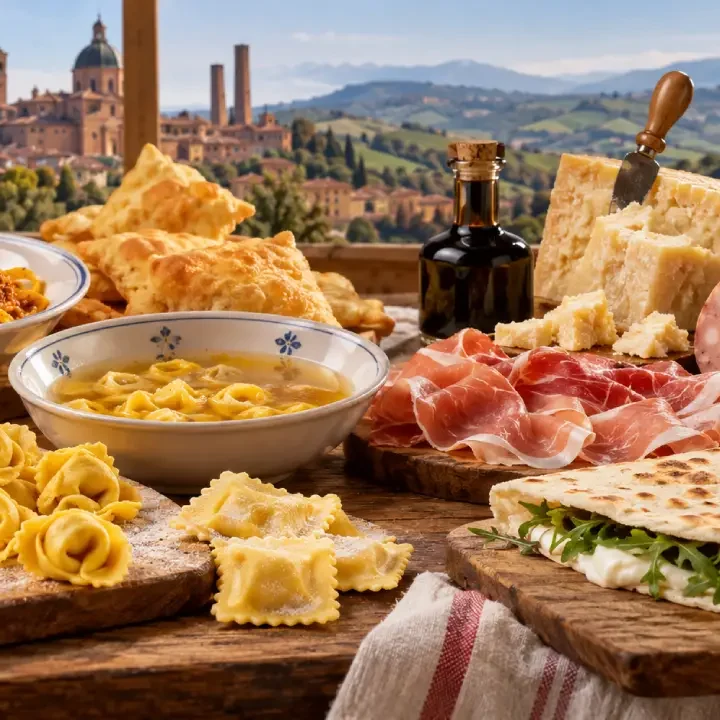
A kitchen table, some flour, eggs and a rolling pin are enough to keep a family busy for most of the morning.
Someone rolls out the pasta, someone prepares the filling, and someone else insists that their grandmother used to make the pasta thinner. And they are probably right, at least in their own home.
That’s often how things work with the food of Emilia-Romagna. A recipe can change from one province to the next, and sometimes you don’t even need to travel that far. The result is generations of arguments and dishes that, fortunately, have never quite reached a final agreement.
This is a cuisine where local rivalry has done an excellent job.
One Egg for Every 100 Grams of Flour
The ratio is simple. What happens next is anything but.
For Tagliatelle al Ragù, the pasta is rolled out, left to dry very slightly, rolled up and cut into ribbons. Width matters so much that Bologna even has a golden model of the traditional tagliatella deposited at the local Chamber of Commerce.
The ragù is another matter. Meat, soffritto, time and a slow, gentle simmer. Ragù alla Bolognese has had an eventful enough history to become famous around the world in forms that people in Bologna would struggle to recognize.
Spaghetti Bolognese is the most obvious example.
Put the ragù on tagliatelle, however, and everything falls back into place.
The same ragù appears in Lasagne Verdi alla Bolognese, layered with béchamel, Parmigiano and green spinach pasta. It is one of those dishes where each preparation could easily stand on its own, yet seems to have been made specifically to end up underneath or on top of something else.
With Tortellini alla Bolognese, things become considerably more patient.
The pasta is rolled thin, cut into small squares, filled and shaped one piece at a time around a finger. Pork loin, prosciutto, mortadella, Parmigiano, eggs and nutmeg all fit inside a few centimetres of pasta.
Then comes the broth.
And that’s where the arguments begin.
Neighbourhood Wars in a Bowl of Broth
Bologna and Modena have been arguing over tortellini for long enough that there is little point in trying to act as referee.
More interesting is what happens when the idea of stuffed pasta changes address.
In Ferrara, pumpkin goes inside the pasta. Cappellacci di Zucca are built around that contrast: naturally sweet pumpkin, Parmigiano, nutmeg and egg pasta.
In Piacenza, tortelli con la coda, literally “tortelli with a tail”, are recognizable before you even taste them. The edges are pinched together in sequence to create a distinctive braided closure. Inside are ricotta, spinach and cheese.
Anolini open another chapter, one that can change easily from family to family and even more between Parma and Piacenza. Fillings differ, preparation methods differ, but broth is difficult to avoid.
Then come Cappelletti Romagnoli, and thinking of tortellini seems reasonable only until you look inside.
Ricotta, raviggiolo, Parmigiano and other cheeses play an important role in many Romagna versions. Around Rimini, you can also find fillings containing meat. At Christmas, cappelletti in broth are a familiar sight on many Romagna tables.
With all these variations, the wisest thing may be not to ask which one is the “real” version.
Parmigiano, Breadcrumbs and an Iron Press
Parmigiano Reggiano keeps turning up.
Inside tortellini. Over tagliatelle. Between layers of lasagne. In cappelletti.
And in Passatelli, it stops being an accompaniment altogether and becomes part of the dough.
Breadcrumbs, Parmigiano, eggs, nutmeg and lemon zest are mixed together and then pushed through a traditional ferro per passatelli, a perforated iron tool. Out come thick, rough strands that are considerably less orderly than tagliatelle.
That’s part of their charm.
Pellegrino Artusi included them in Science in the Kitchen and the Art of Eating Well. The version served in broth remains the most traditional, although today it is easy to find passatelli served dry with fish, vegetables and sauces that Artusi probably never imagined.
Around Ravenna there is another pasta that seems designed to make good use of what was already available in the kitchen.
Spoja lorda is made by spreading a thin layer of cheese filling between two sheets of egg pasta. The whole thing is cut into small squares and cooked in broth.
The name is not particularly elegant. The dish doesn’t need it to be.
One Pig, Plenty of Ideas
If fresh pasta takes over the table, pork takes over a good part of the pantry.
Mortadella Bologna goes into tortellini filling, but it certainly doesn’t need pasta to justify its existence. Thinly sliced or cut into cubes, it is one of the most recognizable flavours of Bologna.
Prosciutto di Parma takes a completely different route: pork leg, salt, air and time.
For Culatello di Zibello, even the cut of meat changes. Ageing in the lowlands around the Po, with their damp air and fog, does the rest.
Then there is gnocco fritto.
The name can be misleading if you’ve never encountered it before: it isn’t a potato gnocco. It is fried dough, puffed and light, served hot with cured meats and cheeses.
Waiting for it to cool would be a waste.
Ferrara joins the pork conversation with Salama da Sugo. Dark, heavily seasoned and aged, it requires long cooking before it reaches the table. It has very little in common with a slice of prosciutto resting on warm gnocco fritto, apart from beginning with the same animal.
Erbazzone Stays in Reggio, Balsamic Travels the World
Erbazzone Reggiano never needed to become famous everywhere to remain one of the most recognizable dishes of Reggio Emilia.
It is a savoury pie filled with chard and other leafy greens, Parmigiano and aromatics. Its roots lie in country cooking, when whatever was growing in the vegetable garden had a very good chance of ending up inside pastry.
In Modena, Aceto Balsamico Tradizionale, traditional balsamic vinegar, followed a very different path.
There is little use for haste here. Cooked grape must undergoes a long ageing process in barrels made from different woods, slowly concentrating until the result bears little resemblance to the vinegar casually poured over a salad.
A few drops are enough.
In Rimini, They Roll Piadina Thinner
Piadina Romagnola solves quite a few problems with flour, water, salt and fat.
It can take the place of bread, be folded around a filling and, most importantly, be eaten straight from the hot cooking surface.
Squacquerone and rocket have become an almost inevitable pairing. But piadina can just as easily hold cured meats, sausage, grilled vegetables or cooked greens.
Ask how thick it should be, however, and another argument begins.
Around Rimini, piadina is thin and flexible. Towards Forlì and Ravenna, it becomes thicker.
Even the name changes when the piadina is folded and sealed around its filling. Around Rimini you will often hear cassone; elsewhere crescione is more common.
None of these details prevents you from eating it with your hands, which is probably the most important part.
When Sardines End Up Inside Piadina
Along the coast, the grill smells different.
Small oily fish, cuttlefish and other catches from the Adriatic go over the heat. Rustida brings fish straight to the grill, often after a light coating of seasoned breadcrumbs, without much need for embellishment.
Local sardines take another route too. Hot, inside a piadina, with radicchio and onion.
The piadina absorbs some of the juices from the fish, the radicchio keeps its bitterness, and the onion certainly doesn’t go unnoticed.
And something will almost certainly fall onto the tablecloth.