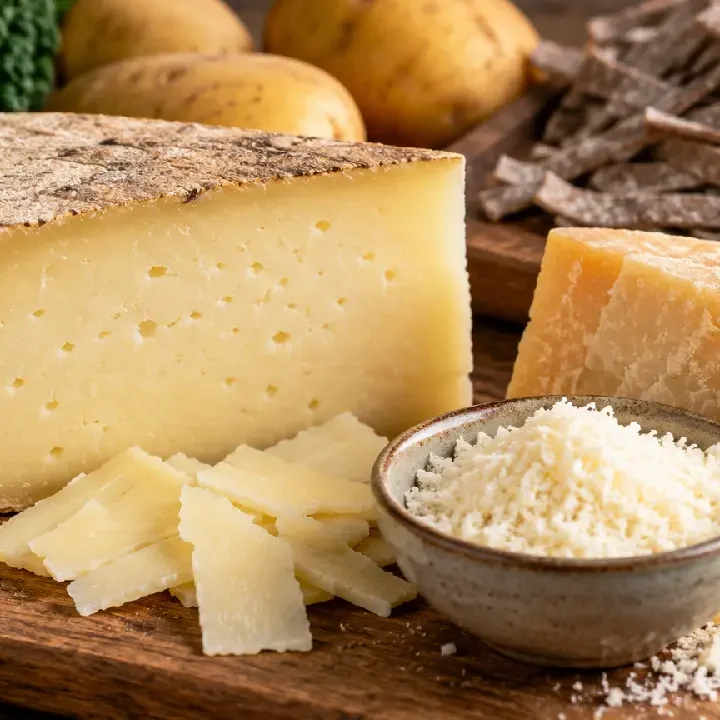
There’s a moment when making pizzoccheri when the pasta, potatoes and Savoy cabbage are still piping hot, and the cheese begins to melt between the layers. That’s when you realise how much choosing the right cheese matters. It isn’t enough for it to melt or become creamy: its flavour also needs to complement the buckwheat, butter and vegetables without overpowering them.
In Valtellina, the cheese of choice is Casera, a local speciality used alongside grated hard cheese in the recipe established by the Accademia del Pizzocchero di Teglio.
Why Valtellina Casera?
Valtellina Casera PDO is a semi-hard cheese made from partially skimmed cow’s milk. Its flavour changes as it matures. When young, it is mild and slightly sweet, with delicate milky notes; as it ages, it develops a fuller, more aromatic character.
For pizzoccheri, it’s best to choose a relatively young Casera. Cut into thin shavings and layered over the freshly cooked pasta, it softens with the heat and brings the ingredients together without turning the dressing into a sauce.
The Accademia’s recipe calls for 250 g of Casera and 150 g of grated hard cheese for four people. The latter adds saltiness and a more pronounced flavour. Grana Padano or Parmigiano Reggiano can both be used, although each gives the dish a slightly different character.
What makes pizzoccheri special is the way everything comes together. The cheese isn’t melted separately in a pan or mixed with cream. Instead, the heat of the freshly cooked pasta melts it between the layers, before hot butter infused with garlic is poured over the top.
To get the best result, cut the Casera into thin shavings rather than large cubes. The serving dish should be hot, and the pizzoccheri should go straight from the cooking water into the dish, alternating with the cheese before they have time to cool. There’s no need to put everything in the oven: the heat of the ingredients does the work.
What About Bitto? Isn’t That Also a Valtellina Cheese?
It certainly is, and one of the region’s best-known cheeses. Bitto PDO is produced during the summer months in Alpine pastures and has deep roots in Valtellina’s mountain cheesemaking traditions.
Its characteristics differ from those of Casera, particularly as it ages. A young Bitto can work well in pizzoccheri, giving the dish a different flavour. A much more mature cheese, however, has a stronger taste and is less suitable for melting between the layers of pasta.
So there’s nothing wrong with finding pizzoccheri made with Bitto, but the recipe established by the Accademia di Teglio specifically calls for Casera. It’s a useful distinction if you want to recreate that particular version of the dish.
If You Can’t Find Casera
Outside Lombardy, especially further away from Valtellina, Casera isn’t always easy to find. That doesn’t mean you have to give up making pizzoccheri, but it’s worth choosing a substitute that won’t completely change the flavour of the dish.
Fontina PDO or a young Montasio PDO can both work well. They soften with heat and have flavours that complement the potatoes and vegetables. A good young Italian-style dairy cheese (formaggio di latteria) is another possibility, provided it isn’t too salty.
I’d avoid smoked or heavily aged cheeses, though. Buckwheat already has a distinctive flavour, the butter adds richness, and the cheese should bring everything together rather than dominate the dish.
Naturally, these substitutions will give you something different from the version prepared in Teglio. If you have the chance to buy Casera, it’s worth trying at least once, not simply to follow the recipe, but to appreciate how much the character of a cheese can influence a dish made with just a handful of ingredients.
👉 Discover our Pizzoccheri della Valtellina recipe, with step-by-step instructions.