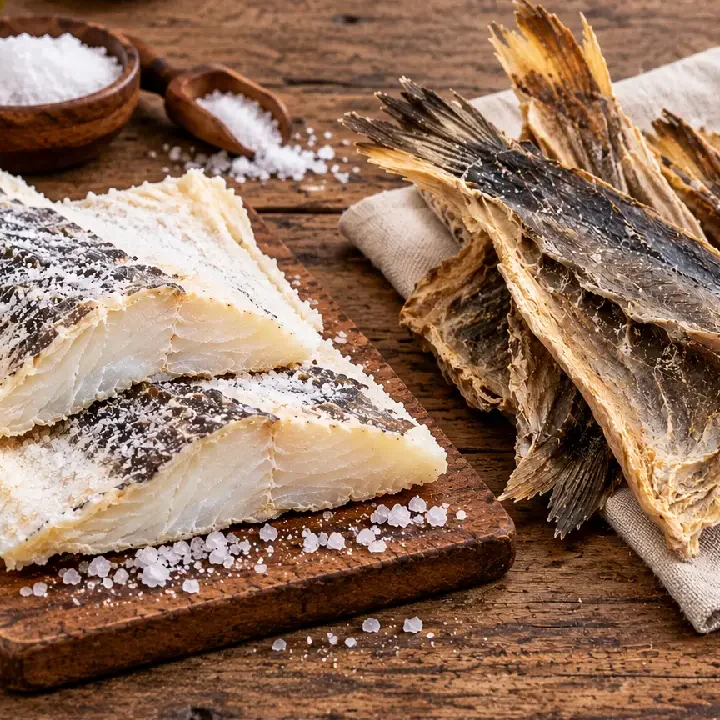
At the fish counter, you might find salt cod and stockfish side by side and wonder which one to choose. At first glance, they seem like two versions of the same product, and in a way they are: both are generally made from cod. But the way they’re prepared makes a considerable difference.
Salt cod is preserved with salt, while stockfish is air-dried without any added salt. That’s the essential distinction, although things become a little more complicated when regional Italian recipes enter the picture. In Veneto, for example, what everyone calls baccalà is often actually stockfish.
Salt cod: preserving fish with salt
Long before refrigerators and freezers existed, salt was one of the most effective ways to preserve fish and transport it far from the places where it was caught.
To make salt cod, the fish is cleaned, split open and covered with salt. In traditional production, it remains salted for around three weeks, gradually losing some of its moisture and developing a firmer texture.
Not all salt cod is processed in exactly the same way, however. Alongside salted cod, there’s also salted and dried cod, which undergoes an additional drying stage after salting. It’s an important distinction: just because a fish is dry doesn’t necessarily make it stockfish.
Before it can be cooked in a pan or casserole, salt cod needs to lose much of the salt absorbed during processing. This means soaking it in cold water for one or more days, a step that can make all the difference to the finished dish. If it hasn’t been properly desalted, even a carefully prepared recipe can end up far too salty.
Stockfish and the winds of the Lofoten Islands
The story of stockfish takes us much further north, to Norway’s Lofoten Islands. Here, cod has traditionally been dried outdoors, hanging from large wooden racks.
It’s not simply a matter of leaving fish in the sun. The local climate makes the process possible: cold air and wind allow the fish to dry slowly, while temperatures need to remain suitable to prevent freezing or spoilage.
Production therefore follows the seasons. Cod caught during winter and spring is hung on the racks and left to dry for around three months. Afterwards, it may undergo a further period of maturation indoors.
By the end of the process, the fish has lost most of its moisture and become extremely hard, almost as stiff as a piece of wood. This characteristic is also reflected in the name stockfish, which is generally linked to northern European terms associated with dried fish.
The result is a product that can be stored and transported for long periods without salting. Over the centuries, this helped stockfish travel far beyond the Norwegian coast.
Before cooking, a little patience is needed
If you buy either product already prepared for cooking, you can skip much of the work. But with heavily salted cod or completely dried stockfish, you’ll need to plan ahead.
Salt cod must be desalted. This generally takes between 24 and 72 hours, depending on the thickness of the pieces and how heavily they’ve been salted. Keep it submerged in plenty of cold water in the refrigerator, changing the water approximately every 8–12 hours. The most reliable way to check whether it’s ready is to cook a small piece and taste it.
Stockfish presents a different challenge. There’s no added salt to remove, but the fish needs to absorb the water it lost during drying. Rehydration can take several days, sometimes a week or longer for particularly thick pieces. Again, use cold water, keep the fish refrigerated and change the water regularly, following the producer’s instructions.
It’s worth taking your time. Fish that’s soft on the outside but still too hard in the centre will be difficult to work with and may cook unevenly.
Fortunately, you can now buy both ready-desalted salt cod and pre-soaked stockfish. They’re convenient options if you want to prepare a recipe without starting the soaking process several days in advance.
Why do Venetians call stockfish baccalà?
This is where a seemingly straightforward distinction becomes rather interesting.
Order Baccalà Mantecato in Venice and you won’t be served salted cod. The traditional dish is made with stockfish, which is first cooked and then worked with oil until it becomes a light, fluffy cream.
The same applies to Baccalà alla Vicentina, where the fish is slowly cooked with onions, milk and oil.
The Venetian habit of calling dried cod baccalà is so deeply rooted that renaming these dishes would almost seem stranger than keeping the apparent contradiction.
The connection between Venice and stockfish also has a fascinating history. In 1432, the Venetian merchant Pietro Querini, having survived a shipwreck during a voyage towards Flanders, reached the Lofoten Islands. There, he met the local inhabitants and observed their method of preserving cod, later describing it in an account of his journey.
This doesn’t mean that stockfish arrived in Italy solely because of him, but his experience remains one of the best-known episodes in the historical relationship between Venice and Norway.
Over time, this fish, easy to transport and store, found its way into the kitchens of several Italian regions. Each developed its own way of preparing it, creating dishes that remain part of local food traditions today.
Which one should you use in your recipes?
The simplest answer is to follow the tradition behind the dish you’re making. Despite their common origin, the two products aren’t always interchangeable: salting and drying affect their flavour, texture and behaviour during cooking.
Salt cod works particularly well in fried dishes and slow-cooked preparations, provided it has been properly desalted. Stockfish, meanwhile, is essential to several regional specialities, particularly those from Veneto.
A perfect example is Baccalà Mantecato, in which cooked stockfish is slowly whipped with oil. There’s no need for cream or butter: the whipping process itself transforms the fish into a soft, creamy mixture, with a few delicate fibres still noticeable.