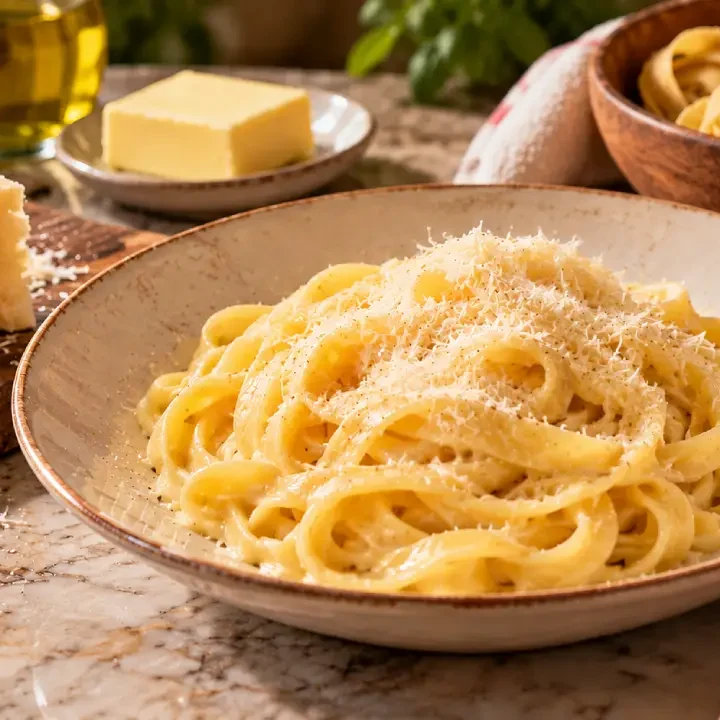
In the United States, Fettuccine Alfredo is one of the best-known pasta dishes. You’ll find it in Italian restaurants, on the menus of major restaurant chains and even among the ready-made sauces on supermarket shelves. In Italy, however, the name often raises a few eyebrows. Some people assume it’s an American invention, while others simply recognise it as fettuccine with butter and Parmigiano.
Yet the story begins in Rome, long before cream-based Alfredo sauces became popular in the United States. It involves an enterprising restaurateur, two silent-film stars and even a pair of golden utensils.
Alfredo Di Lelio, his wife Ines and the first fettuccine
In 1908, Alfredo Di Lelio was working at his family’s trattoria in Piazza Rosa, near what is now the Galleria Alberto Sordi. According to the story passed down through the family, his wife Ines had recently given birth to their son Armando and had lost her appetite while recovering from childbirth.
Alfredo decided to prepare something nourishing and tempting for her: fettuccine generously dressed with butter and Parmigiano. Ines enjoyed the dish, and it eventually became one of the trattoria’s specialities.
Alfredo affectionately called his fettuccine “le bionde”, meaning “the blondes”, a nickname inspired by their golden colour. Over time, they also became known as fettuccine al doppio burro, or double-butter fettuccine, because of the generous amount of butter used.
Of course, the idea of combining pasta with butter and cheese was nothing new. Similar preparations had been part of Italian cooking for centuries. What Di Lelio managed to do was turn a familiar combination into a distinctive dish, associated with his name and a particular way of serving it.
In 1914, he opened Ristorante Alfredo on Via della Scrofa, in central Rome. His fettuccine soon attracted a growing number of customers.
The recipe was simple: fresh egg pasta, butter and Parmigiano. But Alfredo did more than bring the dish to the table. He tossed the fettuccine in front of his guests, using broad, confident movements until the ingredients formed a creamy coating around every ribbon of pasta.
The tossing had become as much a part of the experience as the food itself.
Two Hollywood stars and a golden gift
During the 1920s, Mary Pickford and Douglas Fairbanks, two of the biggest stars of American silent cinema, were among the guests at the restaurant on Via della Scrofa.
The actors, who had married in 1920, tried Alfredo’s fettuccine during a visit to Rome and were delighted with them. According to the restaurant’s account, they returned several times and decided to thank Alfredo with a rather unusual gift.
In 1927, they presented him with a golden fork and spoon, accompanied by an inscription celebrating him as the king of fettuccine.
The utensils became one of the restaurant’s most recognisable symbols. Alfredo used them when serving distinguished guests, while photographs of actors and other famous visitors gradually filled the restaurant’s walls.
Pickford and Fairbanks helped bring international attention to the dish, but the restaurant’s reputation had already reached American literature.
In <Entity category=”book” value=”Babbitt” disambig=”1922 novel by Sinclair Lewis”/>, published in 1922, the American writer Sinclair Lewis has a character mention a small trattoria on Via della Scrofa serving the best fettuccine in the world. The restaurant isn’t named explicitly, but the reference is generally associated with Alfredo’s establishment.
Just eight years after opening, his fettuccine were already well known enough to appear in an American novel.
Why are there two Alfredo restaurants in Rome?
In 1943, Alfredo Di Lelio sold his restaurant on Via della Scrofa to two of his employees, Giuseppe Mozzetti and Ubaldo Salvatori. The restaurant continued operating under the Alfredo name, preserving its tradition of serving the famous fettuccine.
Seven years later, however, Di Lelio returned to the restaurant business. In 1950, he opened a new establishment with his son Armando, called Il Vero Alfredo, in Piazza Augusto Imperatore.
From that point onwards, Rome had two restaurants connected to the same story: Alfredo alla Scrofa, at the location made famous by the founder, and Il Vero Alfredo, subsequently opened by the Di Lelio family.
Both have continued to preserve the tradition of the fettuccine that made Alfredo famous, each following its own path.
When Fettuccine Alfredo became Alfredo sauce
Meanwhile, in the United States, an ingredient absent from the Roman recipe began appearing alongside the butter and Parmigiano: heavy cream.
The difference goes beyond flavour. In the original preparation, butter and Parmigiano are worked together with the hot pasta and a little of its cooking water. The creamy consistency comes from tossing the ingredients together, without needing to prepare a separate sauce.
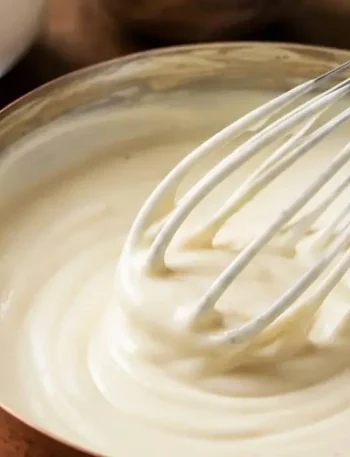
Cream, on the other hand, produces a richer, thicker sauce that can be made before the pasta is cooked.
Exactly when this variation first appeared remains uncertain. It gradually spread through American restaurants and home kitchens, eventually becoming the version most familiar to many diners.
Over time, the meaning of the name changed too. Alfredo no longer referred exclusively to a plate of fettuccine, but also to a creamy sauce used in a variety of dishes.
This is how preparations such as Chicken Alfredo, combining chicken and pasta, became popular, along with versions featuring shrimp, broccoli and other ingredients. The ready-made Alfredo sauces sold in American supermarkets are part of the same evolution.
Today, someone in the United States can buy a jar of Alfredo sauce without ever having heard of Alfredo Di Lelio or his Roman restaurant. The name has survived, while the preparation has developed an identity of its own within Italian-American cuisine.
Why is the name Fettuccine Alfredo less familiar in Italy?
In Italy, by contrast, pasta with butter and Parmigiano is such a familiar combination that many people don’t associate it with a particular restaurateur. Buttered fettuccine can simply be something prepared at home, without any ceremony or a special name on the menu.
In Rome, Alfredo Di Lelio’s story is still remembered, particularly through the restaurants that continue to serve his speciality. Outside the capital, however, the name has never achieved anything like its popularity in the United States.
The widespread American version has also contributed to the confusion. A plate of pasta covered in a generous cream-based sauce, perhaps topped with chicken or broccoli, bears little resemblance to the fettuccine Alfredo prepared in front of his customers.
It’s hardly surprising, then, that many Italians consider Fettuccine Alfredo an American invention. In reality, it’s mainly the cream-based version that’s American, while the dish that gave it its name originated in Rome.
The distinction becomes clear when you taste the original preparation. If you want to enjoy Fettuccine Alfredo as they were made in Rome, there’s no need for cream, chicken or other additions. All you need is fresh egg pasta, butter, Parmigiano and careful tossing to bring everything together.